China Develops AI Wastewater-to-Fertiliser Technology
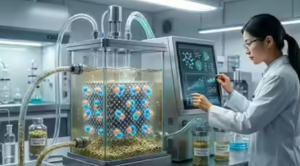
China has developed an AI-powered electrochemical technology that converts nitrate-laden wastewater into ammonia for fertiliser production. The method uses a dual-atom catalyst and operates at room temperature, unlike the conventional Haber-Bosch process used for industrial ammonia synthesis.
AI-Optimised Catalyst Design
The technology uses artificial intelligence to identify a highly effective dual-atom catalyst, often abbreviated as DAC. A dual-atom catalyst contains two adjacent active metal atoms that can improve reaction selectivity and efficiency in chemical conversion processes. The new method converts nitrates found in agricultural runoff and industrial wastewater into ammonia.
Electrochemical Conversion of Nitrates
The process transforms nitrate ions in wastewater into ammonia through electrochemical reduction. Ammonia is a key feedstock for nitrogen fertilisers such as urea and ammonium compounds. The reported conversion efficiency is nearly three times higher than that of earlier technologies for nitrate-to-ammonia conversion.
Haber-Bosch Process and Energy Use
The Haber-Bosch process, developed in the early 20th century, produces ammonia from nitrogen and hydrogen under high temperature and high pressure. It remains one of the most energy-intensive industrial chemical processes. The new electrochemical route works at room temperature and reduces the energy requirement for ammonia production.
Important Facts for Exams
- Ammonia is a colourless gas with the chemical formula NH3 and is a basic raw material for nitrogen fertilisers.
- Nitrates in wastewater commonly come from agricultural runoff, fertiliser use, and industrial effluents.
- The Journal of the American Chemical Society is a peer-reviewed chemistry journal published by the American Chemical Society.
- Chinese Academy of Sciences is China’s national research institution and includes many specialised institutes.
Related Research in Phosphorus Recycling
Chinese research teams have also developed a phosphorus recycling method that converts sewage sludge into phosphorus fertilisers. The process uses modified hydrochar with calcium or magnesium salts to produce precision-engineered fertiliser material.
| Related | |
|---|---|