Saudi Scientists Develop Electricity-Free Cooling Technology
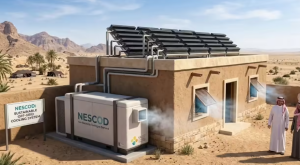
Scientists at King Abdullah University of Science and Technology (KAUST) in Saudi Arabia developed an electricity-free cooling system named Nescod, which stands for No Electricity and Sustainable Cooling on Demand. The system uses ammonium nitrate and water in a chemical cooling process and operates without compressors or continuous electrical power.
Nescod Cooling System
Nescod works on the principle of endothermic dissolution, a process in which a substance absorbs heat while dissolving in water. In this system, ammonium nitrate dissolves in water and lowers the surrounding temperature. The system uses solar energy to evaporate water and regenerate the salt for repeated cooling cycles. Ammonium nitrate is an inorganic salt with the chemical formula NH4NO3 and is known for its use in fertilisers and cooling applications.
Testing and Performance
During testing, the system reduced temperature from about 25°C to nearly 3.6°C in around 20 minutes. The system was nearly four times more efficient than other salts such as ammonium chloride in the same cooling setup. Ammonium nitrate is inexpensive, readily available, and simple to store. These properties make it suitable for cooling systems designed for repeated use in dry and hot environments.
Related KAUST Cooling Research
KAUST researchers led by Professor Qiaoqiang Gan developed a passive radiative cooling method that cools overheating solar panels and collects atmospheric water. The method requires zero electricity and uses radiative heat loss to the sky. Another KAUST-led team developed a low-cost passive cooling material from sodium polyacrylate and lithium chloride. The material captures air moisture at night and releases it during the day to cool solar panels without electricity.
Important Facts for Exams
- KAUST stands for King Abdullah University of Science and Technology and is located in Saudi Arabia.
- Endothermic dissolution is a process in which heat is absorbed when a substance dissolves in a liquid.
- Ammonium nitrate is commonly written as NH4NO3 and is an inorganic salt.
- Passive cooling systems can operate without compressors, motors, or continuous electrical input.
Applications
The technology is relevant for hot climate regions, rural areas with unstable electricity, and low-income households. It is also linked with reduced dependence on conventional air conditioners and lower carbon emissions.
| Related | |
|---|---|