Uttar Pradesh Raises Disaster Relief Compensation
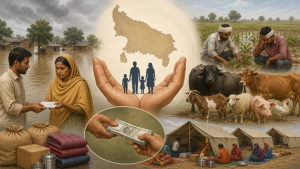
On 6 November 2026, the Uttar Pradesh government revised disaster relief assistance, doubling compensation for a natural-calamity death from ₹4 lakh to ₹8 lakh. The revised norms operate under the State Disaster Response Fund (SDRF) and National Disaster Response Fund (NDRF) frameworks and apply to eligible losses from 1 April to 4 November 2026. The government expects them to benefit more than 10 lakh farmers.
Revised compensation and relief
Crop-loss assistance per hectare rose from ₹17,000 to ₹22,000 in irrigated areas and from ₹8,500 to ₹11,000 in rain-fed areas. Compensation increased from ₹40,000 to ₹50,000 for large-animal deaths and from ₹4,000 to ₹5,500 for goats, sheep and pigs. Rates also rose for poultry (₹100 to ₹130 per bird), load-carrying animals (₹20,000 to ₹25,400), perennial crops and agroforestry (₹22,500 to ₹30,000 per hectare), sericulture (₹6,000 to ₹7,800) and sugarcane (₹7,500 to ₹9,800). Assistance for erosion and landslide losses was also increased.
For 2026–27 to 2030–31, compensation for a fully damaged pucca house is ₹1.85 lakh in plains and ₹2.06 lakh in hilly areas; partial damage attracts ₹93,000 and ₹1.03 lakh, respectively. School repairs can receive up to ₹15.50 lakh for primary schools and ₹26 lakh for secondary schools, intermediate colleges and polytechnics. Industrial or commercial damage caused by fire, explosion or accident is excluded.
Relief camps and delivery
Relief camps provide food, clothing, temporary housing and essentials for 30 days normally, extendable to 60 days or as needed in special circumstances. Drinking-water assistance is set for 30 days normally and 90 days during drought. Aid is transferred through mandatory Direct Benefit Transfer (DBT), and beneficiary lists and eligibility criteria are to be made public.
Important Facts for Exams
- Linked-account transfers: DBT transfers subsidies directly to linked bank accounts, aiming to reduce leakages, duplication and delays while improving transparency and accountability.
- Common payment platform: For DBT, PFMS acts as a common routing platform and supports beneficiary-list preparation, digital signing and bank payments through NPCI’s Aadhaar Payment Bridge.
- State and national fund roles: The SDRF is the primary state-level fund for notified disaster response; NDRF support is supplementary and intended for severe disasters when state resources are inadequate.
- NDRF assessment process: Requests for NDRF assistance are assessed through an Inter-Ministerial Central Team, after which the Union-level High-Level Committee considers release decisions.
| Related | |
|---|---|