Scientists Identify 4.1-Billion-Year-Old Martian Meteorite
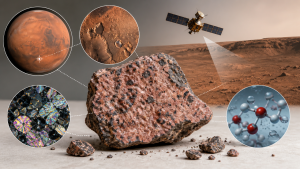
Scientists identified Teghaza 001, a rose-coloured meteorite found in Mali’s Sahara Desert, as a piece of Mars formed at least 4.1 billion years ago. Meteorite hunters discovered it in 2022 on a salt plain. The findings were published in Science on 29 October 2026, with planetary scientist Yang Liu of NASA’s Jet Propulsion Laboratory as lead author.
Composition and evidence of ancient water
The meteorite comprises eight fragments weighing about 798.5 grams in total. Its chemical and mineral composition, including zircon crystals, distinguishes it from previously studied Martian samples. It resembles materials observed in Mars’ southern highlands by the Mars Reconnaissance Orbiter, and scientists identified 13 potential Martian locations matching its mineralogy and chemistry.
Analysis indicates that water altered Mars’ crust at least 4.1 billion years ago. The finding points to a water cycle on ancient Mars and conditions that could have been suitable for life. Teghaza 001 is among the three oldest Martian meteorites found on Earth.
Important Facts for Exams
- Martian meteorite groups: The principal Martian meteorite groups are shergottites, nakhlites and chassignites, named after their type meteorites and distinguished chiefly by mineralogy and texture.
- Atmospheric evidence: Some Martian meteorites contain shock-formed glass pockets whose trapped gas isotope patterns closely match the atmosphere measured by Viking landers, helping establish their Martian origin.
- Zircon geochronology: Zircon's crystal structure accepts uranium but initially excludes lead, making uranium–lead isotopes useful for dating crystallisation even when surrounding rocks undergo alteration.
- Orbital mineral mapping: MRO's CRISM instrument records reflected visible and near-infrared spectra, allowing scientists to map surface minerals from diagnostic absorption features rather than direct sampling.
| Related | |
|---|---|