India’s Nuclear Warheads See First Operational Deployment
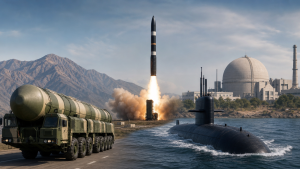
India’s nuclear arsenal was estimated at 190 warheads in January 2026, and 12 of these warheads were reported as operationally deployed as of 30 June 2026. The Stockholm International Peace Research Institute 2026 Yearbook recorded this as the first known operational deployment of Indian nuclear warheads.
Operational Deployment of Nuclear Weapons
Operational deployment means that warheads are placed with active military units, mated with delivery systems, and kept ready for use. In nuclear force structure, this status differs from warheads kept in storage or held separately from missiles and aircraft.
India’s Nuclear Doctrine
India follows a declared no first use policy, under which nuclear weapons are used only in retaliation to a nuclear attack. India’s nuclear doctrine also places emphasis on credible minimum deterrence and civilian control of nuclear forces.
Delivery Systems and Second-Strike Capability
India’s sea-based deterrent includes nuclear ballistic missile submarines of the Arihant class. Sea-based platforms support second-strike capability because submarines can remain hidden at sea and can survive a first attack more effectively than fixed land-based systems.
Agni-Series Missiles and Canisterisation
India is using canisterised Agni-series missiles for longer-range delivery. Canisterisation stores a missile and warhead in a sealed launch tube, which reduces preparation time and improves survivability during storage and transport.
Nuclear Command Authority
The Nuclear Command Authority of India handles command, control, and operational decisions for nuclear weapons. It has a Political Council chaired by the Prime Minister and an Executive Council chaired by the National Security Adviser.
Important Facts for Exams
- The Stockholm International Peace Research Institute publishes the annual Yearbook on world armaments, disarmament, and international security.
- India conducted its first nuclear test, Pokhran-I, in 1974 at the Pokhran Test Range in Rajasthan.
- India conducted a series of nuclear tests, Pokhran-II, in 1998 at the Pokhran Test Range in Rajasthan.
- SSBN stands for nuclear ballistic missile submarine, which is a submarine designed to carry submarine-launched ballistic missiles.
| Related | |
|---|---|