Types of Sprint Races in Athletics
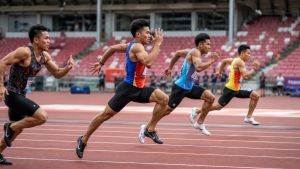
Sprint races are the fastest events in athletics, where success depends on explosive starts, acceleration, maximum velocity and controlled speed endurance. They are central to track and field at the Olympic Games, Asian Games and World Athletics Championships. Short races also test lane discipline, baton exchange efficiency and precise timing, making them a compact but technically demanding part of competition.
Fundamentals of Sprinting
Sprint races are run over short distances on a track and require athletes to reach top speed quickly and maintain it for as long as the event demands. Unlike middle- and long-distance races, sprinting is built around power, reaction time and race execution rather than pacing.
- Starting blocks: Used in sprint starts to provide a stable base and help athletes generate maximum force in the first steps.
- Start sequence: The starter calls “On your marks,” then “Set,” followed by the gun. Movement after “Set” but before the gun is treated as a false start.
- False start rule: Under current rules, a false start by an athlete usually leads to disqualification.
- Lanes: Sprint races are held in lanes to ensure fairness. Lane infringement can lead to disqualification.
- Track surface: Modern synthetic tracks are designed to provide traction and consistent performance for high-speed running.
Sprint events also rely heavily on sports science. Training focuses on explosive strength, reaction drills, running mechanics, and performance analytics that help coaches study stride length, stride frequency, and split times. In elite competitions, even small technical errors can affect medal outcomes.
Individual Sprint Events
Individual sprint races are contested by athletes running alone against the clock and against others in their lanes. The best-known sprint events are the 100 metres, 200 metres and 400 metres, with the 60 metres mainly used indoors.
- 100 metres: The shortest outdoor sprint and often regarded as the premier test of pure speed. Athletes stay in their lanes throughout the race.
- 200 metres: Covers half of a standard 400-metre track lap. It begins on a bend and finishes on the straight, combining bend running, acceleration and speed maintenance.
- 400 metres: A full lap of the track and widely described as a long sprint. It demands both high speed and speed endurance.
- 60 metres: Mainly an indoor sprint. It places great importance on reaction time and acceleration because there is very little distance to recover from a slow start.
The 200 metres is especially technical because athletes must control their posture on the bend before driving into the straight. The 400 metres is tougher on endurance, but it still belongs to the sprint category because of its high-speed nature. The 100 metres remains the most iconic sprint because it showcases raw acceleration and maximum velocity in the purest form.
Relay Sprint Events
Relay races are team sprint events in which four athletes combine to complete the distance and pass a baton. The quality of baton exchange is as important as running speed and can decide the race.
- 4×100 metres relay: Each of the four runners covers 100 metres. Baton changes must take place within the exchange zone, and clean exchanges are essential for success.
- 4×400 metres relay: Each runner covers 400 metres. The first leg is usually run in lanes, while later legs may break to the inside lane after the opening phase.
- Exchange zones: Baton exchanges must happen inside the marked zones; a faulty exchange can cost the team disqualification or a major time loss.
- Team coordination: Relay success depends on baton timing, acceleration into the exchange and smooth lane running.
Relay races often reward depth in a team’s sprint programme. A nation with multiple strong runners may still lose if baton handling is poor, while a well-organised team can beat faster individual sprinters through clean changeovers and race control.
Technical Regulations and Equipment
Sprint races follow strict technical rules set by World Athletics. These rules ensure fairness, consistency and reliable record recognition across competitions.
- Timing: Official times are recorded electronically to hundredths of a second. This is essential in close finishes where medals may be decided by very small margins.
- Wind reading: Wind gauges measure tailwinds in sprint races. For record purposes, the maximum legal tailwind is +2.0 metres per second.
- Lanes: Standard outdoor tracks usually have 6 to 9 lanes, and each lane is about 1.22 metres wide.
- Spikes: Sprint shoes are lightweight and fitted with spikes for grip and traction on the track surface.
- Uniforms: Athletes wear close-fitting gear designed to reduce resistance and support free movement.
Because sprint races are decided in fractions of a second, technical compliance matters as much as physical ability. A good start, correct lane running and efficient baton exchange are all part of competitive execution.
Governing Bodies and Major Competitions
The international governing body for athletics is World Athletics, formerly known as the International Association of Athletics Federations (IAAF). It frames the rules, equipment standards and competition regulations used worldwide.
- Olympic Games: Held every four years and regarded as the highest stage for sprint competition.
- World Athletics Championships: A major global athletics event organised by World Athletics.
- Asian Games: A multi-sport continental event organised by the Olympic Council of Asia and held every four years.
- Other continental meets: Regional championships such as the European Championships and Commonwealth Games also feature sprint events prominently.
Athletics is a core sport at major multi-sport events because sprint finals draw large audiences and often produce the most dramatic finishes. Medal decisions are made separately in each final, and the smallest time gap can determine podium positions.
Key Prelims Takeaways
- Core sprint events: 100m, 200m and 400m are the main outdoor sprint races; 60m is mainly indoor.
- Race types: Sprint events include both individual races and relays.
- Relay events: The standard relay sprints are 4x100m and 4x400m.
- False start: Movement after “Set” and before the gun is treated as a false start under current rules.
- Timing: Sprint times are recorded electronically to two decimal places.
- Wind limit: The legal tailwind for record purposes is +2.0 m/s.
- World body: World Athletics is the international governing body for track and field.
Recent Context
At the 20th Asian Games in Aichi-Nagoya, Harita Bhadra won bronze in the women’s 200m final on September 27, 2026, clocking 23.20 seconds. Singapore’s Shanti Pereira took gold in 22.78 seconds and China’s Yujie Chen won silver in 22.93 seconds, underlining how tight sprint finals can be.
| Related | |
|---|---|