Seventh Central Pay Commission: Recommendations and Implementation
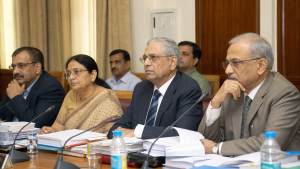
The Seventh Central Pay Commission (7th CPC) reshaped the salary, allowance and pension framework for central government employees and pensioners. It replaced the older grade pay system with a unified Pay Matrix and revised key service benefits, gratuity and allowances.
Establishment and composition
- Constitution: The Government of India constituted the 7th CPC on 28 February 2014.
- Chairman: It was headed by retired Supreme Court Justice Ashok Kumar Mathur.
- Members: Vivek Rae was the Full-Time Member, Dr. Rathin Roy the Part-Time Member, and Meena Agarwal the Secretary.
- Final report: The commission submitted its 899-page report on 19 November 2015.
- Implementation: The Union Cabinet approved the recommendations on 29 June 2016, with effect from 1 January 2016.
Pay structure overhaul
- Unified Pay Matrix: The 7th CPC replaced the 6th CPC system of separate Pay Bands and Grade Pay with a single Pay Matrix.
- Pay Level: An employee’s position in the structure is determined by the assigned Pay Level.
- Fitment factor: A uniform fitment factor of 2.57 was used to move employees from the 6th CPC basic pay to the new matrix.
- Minimum pay: The minimum monthly basic pay for central government employees was raised from ₹7,000 to ₹18,000.
- Maximum pay: The ceiling was fixed at ₹2,25,000 for Apex Scale officers and ₹2,50,000 for the Cabinet Secretary and equivalent posts.
- Annual increment: The increment rate remained at 3%.
| Parameter | Sixth Central Pay Commission | Seventh Central Pay Commission |
| Core structure | Separate Pay Bands and Grade Pays | Unified Pay Matrix with Pay Levels |
| Minimum monthly pay | ₹7,000 | ₹18,000 |
| Maximum monthly pay | ₹90,000 | ₹2,50,000 |
| Gratuity ceiling | ₹10 lakh | ₹20 lakh |
| Fitment factor | Varied by grade | Uniform 2.57 |
Allowances and service benefits
- Allowance rationalisation: The commission recommended abolition of 52 allowances and simplification of the remaining ones.
- House Rent Allowance (HRA): HRA was fixed at 24%, 16% and 8% for X, Y and Z category cities, respectively.
- MACP benchmark: The benchmark for the Modified Assured Career Progression scheme was raised from “Good” to “Very Good”.
- House Building Advance (HBA): The advance was fixed at 34 times the basic pay or ₹25 lakh, whichever is lower.
- Gratuity cap: The Death-cum-Retirement Gratuity ceiling was increased from ₹10 lakh to ₹20 lakh.
Important exam fact: The 7th CPC introduced the Pay Matrix and applied a uniform fitment factor of 2.57.
Why the 7th CPC mattered
- Transparency: The Pay Matrix made salary progression easier to understand than the earlier grade pay system.
- Standardisation: A common fitment factor created a uniform transition from the old pay structure.
- Retiral protection: Higher gratuity limits improved post-retirement financial security.
- Allowance control: Rationalisation of allowances aimed to reduce overlap and fiscal burden.
- Career progression: A stricter MACP benchmark linked financial progression to a stronger performance standard.
Key Prelims Takeaways
- Constitution date: The 7th CPC was set up on 28 February 2014.
- Chairman: Justice Ashok Kumar Mathur headed the commission.
- Core change: It replaced Pay Bands and Grade Pay with a unified Pay Matrix.
- Fitment factor: The transition multiplier was 2.57.
- Minimum basic pay: The entry-level pay was fixed at ₹18,000 per month.
- HRA rates: X, Y and Z city rates were 24%, 16% and 8%.
- Gratuity ceiling: DCRG was raised to ₹20 lakh.
Current General Studies comprises current-affairs-based, General Studies-rich study material on policies, laws, institutions, economy, science, environment, governance, international relations, and other varied but important topics for UPSC and State PSC Prelims examinations.
Fortnightly PDF compilations: Available here
Originally written on
March 31, 2026
and last modified on
September 5, 2026.
| Related | |
|---|---|