Important Ports on the Indian Ocean Rim
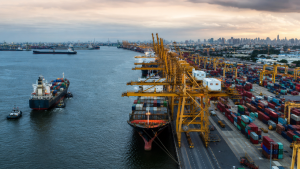
Ports along the Indian Ocean Rim are central to maritime trade, energy movement and regional connectivity. Their location near key sea lanes gives them importance for commerce, logistics, naval power and geopolitical influence across Asia, Africa and the wider Indian Ocean basin.
Indian Ocean Rim: Strategic Importance
The Indian Ocean is the third-largest ocean and covers nearly one-fifth of the world’s ocean surface. It links Africa, Asia, Australia and the Middle East, and carries a major share of global energy and cargo traffic. Its sea lanes and chokepoints shape trade flows, supply chains and strategic competition.
- Global trade role: More than 80% of the world’s seaborne oil trade and about 33% of bulk cargo traffic pass through Indian Ocean waters.
- Chokepoints: The Strait of Hormuz, Bab-el-Mandeb and the Strait of Malacca are the most critical maritime bottlenecks in the region.
- IORA: The Indian Ocean Rim Association, established in 1997, promotes regional cooperation and sustainable development among 23 member states and 11 dialogue partners.
- Security value: Stability of shipping lanes is essential for energy security, maritime commerce and naval operations.
Key Ports of South Asia
South Asia hosts several ports that connect domestic markets with global shipping routes. Some are major container hubs, while others handle crude oil, iron ore, coal and transhipment traffic.
- India: India has 12 major ports and around 200 non-major ports along its coastline.
- Mumbai Port: One of India’s oldest and largest ports, handling a wide range of cargo.
- Jawaharlal Nehru Port Trust (JNPT): India’s largest container port.
- Deendayal Port (Kandla): A tidal port in Gujarat, important for crude oil and petroleum products.
- Mormugao Port: A natural harbour in Goa, mainly associated with iron ore exports.
- New Mangalore Port: Handles petroleum products, crude oil and iron ore.
- Kochi Port: A major transhipment hub and natural harbour on the Arabian Sea.
- V.O. Chidambaranar Port: An artificial deep-sea harbour at Tuticorin in Tamil Nadu.
- Chennai Port: India’s second-largest container port.
- Kamarajar Port (Ennore): India’s first corporatised major port.
- Visakhapatnam Port: A natural harbour and one of the deepest landlocked ports.
- Paradip Port: A deep-water port handling iron ore and coal.
- Haldia Dock Complex: A major riverine port on the Hooghly River.
- Sri Lanka: The Port of Colombo is the country’s largest port and a major transhipment hub near international shipping lanes.
- Hambantota Port: Developed with Chinese investment and strategically located south of major shipping routes.
- Bangladesh: Chittagong Port is the busiest seaport, while Mongla Port is the second-largest port, on the Pasur River.
- Pakistan: Karachi Port handles roughly 60% of national cargo; Port Qasim is the second-largest port; Gwadar is a deep-sea port developed under CPEC.
- Maldives: Malé hosts the main port for the archipelago and handles most imports and exports.
Ports in West Asia and East Africa
This corridor is vital for oil exports, transhipment and access to landlocked states. Ports here often serve as gateways to inland regions far beyond the coastline.
- Chabahar Port: Located on the Gulf of Oman, it is Iran’s only oceanic port and provides India access to Afghanistan and Central Asia without crossing Pakistan.
- Bandar Abbas: Iran’s largest port, located on the Strait of Hormuz.
- Port of Salalah: A major transhipment hub on the Arabian Sea and an important East-West trade node.
- Port of Duqm: A major port and special economic zone project on Oman’s Arabian Sea coast.
- Jebel Ali Port: Dubai’s key port and the largest in the Middle East.
- Port of Djibouti: Located near the Bab-el-Mandeb Strait, it is a strategic transhipment point and gateway to Ethiopia.
- Port of Mombasa: East Africa’s largest and busiest port, serving Kenya and landlocked neighbours such as Uganda, Rwanda and South Sudan.
- Port of Dar es Salaam: A principal East African port providing access to Zambia, Congo, Burundi and Rwanda.
Major Southeast Asian Ports
Southeast Asian ports connect East Asia with the Indian Ocean and are central to global supply chains. Several of them are among the world’s busiest transhipment hubs.
- Port of Singapore: One of the world’s busiest ports and a leading global transhipment hub.
- Port Klang: Malaysia’s largest and busiest port.
- Port of Tanjung Pelepas: A major container terminal and transhipment hub in Malaysia.
- Tanjung Priok Port: Indonesia’s busiest and largest port, based in Jakarta.
- Laem Chabang Port: Thailand’s largest deep-sea port and an industrial-export hub.
Connectivity Initiatives and Port Development
Port infrastructure is increasingly being shaped by regional connectivity plans. These initiatives link ports with rail, road and inland routes to reduce logistics costs and expand trade reach.
- Sagarmala Programme: Launched in 2015, it focuses on port modernisation, new port construction, connectivity improvement, coastal community development, and coastal shipping and inland waterways.
- Trade efficiency: Sagarmala aims to reduce logistics costs for EXIM and domestic trade.
- Belt and Road Initiative (BRI): China has invested in port infrastructure across the Indian Ocean Rim, including Gwadar, Hambantota and Djibouti.
- String of Pearls: The term is often used for China’s network of maritime footholds along key sea routes.
- INSTC: The International North-South Transport Corridor is a 7,200 km multi-modal route linking India, Iran, Afghanistan, Armenia, Azerbaijan, Russia, Central Asia and Europe.
- Chabahar’s role: Chabahar Port is a crucial part of the INSTC and offers an alternative transit route.
- IMEC: The India-Middle East-Europe Economic Corridor, announced in 2023, seeks to connect India to Europe through the Middle East by rail and shipping links.
Key Prelims Takeaways
- Indian Ocean significance: It is the third-largest ocean and a major route for seaborne oil and bulk cargo.
- Vital chokepoints: The Strait of Hormuz, Bab-el-Mandeb and Strait of Malacca are critical for global trade and energy flows.
- IORA: Established in 1997, it promotes cooperation among 23 member states.
- India’s key port: JNPT is India’s largest container port.
- Strategic Iranian port: Chabahar is Iran’s only oceanic port and supports access to Afghanistan and Central Asia.
- Major transhipment hubs: Colombo, Singapore and Jebel Ali are among the most important in the wider Indian Ocean network.
- Connectivity schemes: Sagarmala, INSTC and IMEC are important port-led and corridor-based initiatives.
Recent Context
The track-laying operation on the Chabahar-Zahedan railway was completed in September 2026. This line connects Chabahar Port on the Gulf of Oman with Iran’s rail network through Zahedan, improving multimodal access to Afghanistan, Central Asia and eastern Russia while bypassing Pakistan.
| Related | |
|---|---|