Olympic and Asian Games Combat Sports: Key Rules and Formats
Introduction
Combat sports at the Olympic and Asian Games follow tightly defined rules to ensure fair competition, safe conduct and clear results. Each discipline uses a different scoring system, bout format and victory condition, making them important for Prelims revision. Understanding these formats helps in recalling how medals are decided in boxing, wrestling, judo, taekwondo and fencing.
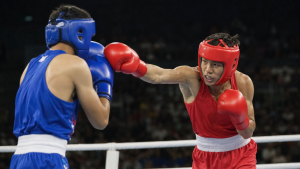
Boxing: Rounds, Scoring and Decisions
Boxing in the Olympic and Asian Games is contested in weight categories so that athletes face opponents of similar build. The bout structure is simple, but the judging criteria and possible outcomes are varied, which makes the sport highly relevant for objective exam questions.
- Rounds: Bouts typically consist of three rounds. Men’s rounds last three minutes each, while women’s rounds last two minutes each.
- Judging: A panel of five judges scores each round. Clean blows, aggression, dominance and defensive skill are considered.
- Weight categories: International amateur boxing includes divisions such as men’s 80kg, women’s 65kg and men’s +90kg.
- Unanimous Decision (UD): All five judges score the bout for one boxer.
- Split Decision (SD): The judges are divided, such as three in favour of one boxer and two for the other.
- Knockout (KO): A boxer is unable to resume after a ten-second count.
- Referee Stops Contest (RSC): The referee ends the bout before the final bell because of safety concerns or clear dominance by one boxer.
- Walkover (WO): An opponent fails to appear or cannot compete.
- Disqualification (DSQ): A boxer is removed for repeated rule violations.
In Asian Games boxing, the tournament follows a knockout system: quarter-final winners move to the semi-finals, and every semi-finalist is guaranteed at least a bronze medal.
- Bronze medals: There is no bronze-medal match in Asian Games boxing; both losing semi-finalists receive bronze.
- Bracket logic: The knockout format makes each quarter-final a direct path to a medal position.
Wrestling: Freestyle and Greco-Roman
Wrestling in multi-sport events is divided into Freestyle and Greco-Roman, both of which aim at pinfall or point victory. The bouts are built around control, takedowns and tactical counters, with the rules clearly distinguishing allowed holds and scoring actions.
- Freestyle: Wrestlers may attack using the whole body, including leg attacks.
- Greco-Roman: Holds below the waist are not allowed; the style focuses on upper-body throws and lifts.
- Bout length: Matches typically consist of two three-minute periods with a 30-second break.
- Scoring actions: Points are awarded for takedowns, reversals, exposures and cautions.
- Pinfall (Fall): A wrestler wins immediately by holding both shoulder blades of the opponent to the mat for a brief period.
- Technical superiority: The bout ends early when one wrestler builds an unassailable lead.
- Points victory: If neither a pinfall nor technical superiority occurs, the wrestler with more points wins at full time.
Judo: Ippon, Waza-ari and Penalties
Judo is built on throws, holds and submissions, with victory often decided by a single high-quality movement. The scoring system is compact, which is why judo questions in Prelims usually focus on the exact meaning of Ippon, Waza-ari and penalties.
- Ippon: The highest score and an immediate win.
- Ippon can be scored by: A clean throw with force and speed, a pin for 20 seconds, or a submission through chokehold or armlock.
- Waza-ari: The second-highest score.
- Two Waza-ari: Two Waza-ari scores in one bout equal an Ippon.
- Waza-ari situations: A throw lacking one element of Ippon, or a hold lasting 10 to 19 seconds.
- Shido: Minor infringements lead to penalty warnings.
- Hansoku Make: Three Shido warnings result in disqualification.
- Golden Score: If the match is tied, it moves to sudden death; the first score or penalty against the opponent decides the winner.
Taekwondo: Points, Protectors and Penalties
Taekwondo is known for fast kicking techniques and a clear electronic scoring structure. Athletes wear protective equipment, and only specific target areas are valid, which keeps the contest highly rule-bound and easy to test in revision exams.
- Protective gear: Competitors wear a hogu, head protector, forearm guards, shin guards and a groin guard.
- Bout format: Matches consist of three two-minute rounds.
- Valid targets: The trunk protector and the head.
- Punches: Allowed only to the trunk protector.
- Basic scoring: One point for a punch to the trunk, two points for a kick to the trunk and three points for a kick to the head.
- Turning kick bonus: Turning kicks score higher, with 4 points for the trunk and 5 points for the head.
- Gam-jeom: Penalties are given for faults such as falling, stepping out of bounds or attacking below the waist; each penalty gives one point to the opponent.
- Knockout: A match may end if a legitimate technique leaves the opponent unable to continue.
- Point gap: A large enough lead can stop the contest before the final round in certain formats.
Fencing: Disciplines and Targets
Fencing is a combat sport fought with bladed weapons and is divided into three disciplines. Each discipline has its own target area and right-of-way logic, making it one of the most technical events in the Games.
- Foil: A light thrusting weapon with the torso as the valid target area, excluding the arms, legs and head.
- Right of way: Foil uses priority rules to decide who scores when both fencers land touches.
- Épée: A heavier thrusting weapon with the entire body as the valid target.
- No right of way: In épée, simultaneous touches can count for both fencers.
- Sabre: A light cutting and thrusting weapon with target areas above the waist, excluding the hands.
- Scoring: Touches are registered electronically.
- Bout format: Direct elimination bouts are typically played to 15 points.
- Winner: The first fencer to reach the required score, or the one with more touches when time expires, wins.
Key Prelims Takeaways
- Boxing: Olympic and Asian Games boxing is divided into weight categories and scored round by round by five judges.
- UD in boxing: A unanimous decision means all judges score for one boxer.
- RSC: Referee Stops Contest ends a bout for safety reasons or clear dominance.
- Asian Games boxing: Quarter-final winners reach the semi-finals, and both losing semi-finalists receive bronze medals.
- Wrestling: Freestyle allows leg attacks, while Greco-Roman restricts attacks below the waist.
- Judo: Ippon is an immediate win, and two Waza-ari scores equal one Ippon.
- Taekwondo and fencing: Taekwondo uses point-based kicking and punching rules, while fencing has Foil, Épée and Sabre with different targets and priority rules.
Recent Context
On September 27, 2026, Indian boxers Ankush Panghal, Parveen Hooda and Narender Berwal reached the Asian Games semi-finals, confirming at least bronze medals under the knockout format. Parveen Hooda won 5-0 against a world championships silver medallist, while Narender Berwal advanced by RSC and secured his second consecutive Asian Games medal.
| Related | |
|---|---|