Types of Martian Meteorites and Their Identification
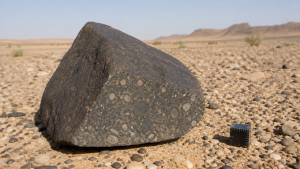
Martian meteorites are fragments ejected from Mars by asteroid or comet impacts that later reach Earth. Their minerals, ages and trapped gases provide direct evidence about Martian geology and atmosphere, while some also preserve signs of ancient water alteration.
Formation and Journey to Earth
Powerful impacts on Mars can eject surface rocks into space. Some fragments travel through the Solar System and enter Earth’s atmosphere, with a fraction surviving the descent to reach the surface. Their journeys may last millions of years. Many are found in deserts, including the Sahara, and in Antarctica, where contrasting surroundings can make them easier to discover and help preserve them. Meteorites from Mars offer samples of the planet that can be studied directly on Earth, complementing observations made by spacecraft.
- Ejection: Impact forces launch Martian rocks beyond the planet’s surface.
- Arrival: Ejected fragments travel through space before entering Earth’s atmosphere.
- Recovery: Desert and polar environments are important meteorite-finding regions.
Principal Martian Meteorite Groups
Most known Martian meteorites belong to three groups: shergottites, nakhlites and chassignites. The collective term SNC comes from the type meteorites Shergotty, Nakhla and Chassigny. The groups are distinguished chiefly by mineralogy and texture.
- Shergottites: These account for roughly 80% of known Martian meteorites. They are igneous rocks formed from cooled magma, commonly containing pyroxene and plagioclase. Their crystallisation ages are generally about 150–600 million years, indicating relatively recent Martian volcanic activity. Based on mineral content, they include basaltic, olivine-orthopyroxene and lherzolitic types. Many show shock metamorphism associated with impact ejection.
- Nakhlites: These are clinopyroxenites rich in augite, with minor olivine, and have crystallisation ages of about 1.3 billion years. Their coarse-grained texture distinguishes them from other groups. Many show aqueous alteration, including iddingsite, a mixture of clay minerals, iron oxides and ferrihydrite. Such alteration indicates that water interacted with rocks in the Martian crust.
- Chassignites: This rare group consists mainly of dunite, a rock composed almost entirely of olivine. Chassigny and NWA 2737 are its two known specimens. Their crystallisation ages are around 1.3 billion years, similar to those of nakhlites.
How Martian Meteorites Are Identified
Identification relies on several independent lines of evidence. Researchers compare meteorites’ gases, mineralogy, chemistry and ages with measurements and observations of Mars. No single feature needs to carry the entire case; converging evidence helps establish a Martian origin and characterise each sample.
- Trapped atmospheric gases: Some meteorites contain shock-formed glass pockets with tiny gas bubbles. The isotopic patterns of gases in these pockets closely match the Martian atmosphere measured by the Viking landers in the 1970s. Ratios of noble gases such as argon, krypton and xenon provide particularly useful evidence.
- Mineralogy and chemistry: Researchers examine minerals, bulk composition and trace elements, as well as isotopic ratios of elements such as oxygen, silicon and chromium. Iron-rich olivine and pyroxene are among the minerals considered when comparing samples with materials associated with Mars.
- Zircon geochronology: Zircon incorporates uranium into its crystal structure but initially excludes lead. Uranium–lead isotopes can therefore be used to determine crystallisation ages, including in rocks that have undergone later alteration.
- Orbital comparison: Spacecraft observations help researchers compare meteorite composition with Martian surface materials. The Mars Reconnaissance Orbiter (MRO) mapped minerals using diagnostic absorption features in reflected light. Its Compact Reconnaissance Imaging Spectrometer for Mars (CRISM) was decommissioned on April 4, 2023.
Scientific Significance
Martian meteorites preserve a record extending from ancient crustal materials formed more than four billion years ago to much younger volcanic rocks. This range helps reconstruct the planet’s geological and magmatic history. Mineral evidence of water alteration also informs research into the ancient Martian water cycle. Organic molecules found in some samples have prompted investigation of the possibility of ancient life, but their origin may be Martian or the result of terrestrial contamination. Their interpretation therefore requires careful testing. More broadly, meteorite studies demonstrate how planetary science combines laboratory analysis with spacecraft observations to evaluate evidence about another world.
Key Prelims Takeaways
- Martian meteorites are impact-ejected fragments of Mars that reached Earth.
- The three principal SNC groups are shergottites, nakhlites and chassignites.
- Shergottites are the most common group and generally date to 150–600 million years ago.
- Nakhlites are augite-rich clinopyroxenites; chassignites are olivine-rich dunites.
- Trapped gas isotope patterns matching Viking lander measurements help establish Martian origin.
- Zircon uranium–lead dating and orbital mineral comparisons provide complementary evidence.
Recent Context
Teghaza 001, discovered in Mali’s Sahara in 2022, comprises eight fragments with a total mass of about 798.5 grams. Findings published in Science on October 29, 2026, indicate that water altered Mars’ crust at least 4.1 billion years ago. It is among the three oldest Martian meteorites found on Earth.
| Related | |
|---|---|