Scientists Discover Earth-Like Exoplanet GJ 3378b
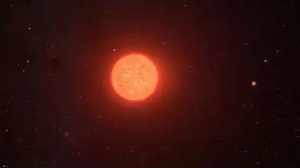
GJ 3378b is an exoplanet orbiting the red dwarf star Gliese 3378, which lies about 25 light-years from the Solar System in the northern constellation Camelopardalis. The planet was first identified in 2024 and later re-analysed by astronomers at the University of California, Irvine, with revised measurements published on 1 July 2026.
Exoplanet and Host Star
GJ 3378b orbits a faint red dwarf star, and red dwarfs are low-mass stars that are common in the Milky Way. The host star’s location in Camelopardalis places the system in the northern sky, and the star’s faintness makes precision measurements difficult.
Mass, Orbit and Habitable Zone
The revised mass of GJ 3378b is about 2.3 times the mass of Earth, compared with an earlier estimate of about 5.26 to 5.3 Earth masses. Its orbital period is 21.45 days, compared with an earlier estimate of 25 days, and this orbit places it within the star’s habitable zone. The habitable zone is the region around a star where liquid water can exist on a planet’s surface if the planet has a suitable atmosphere. GJ 3378b receives about 90% of the radiation that Earth receives from the Sun, which places it near the inner part of the star’s habitable zone.
Detection Methods and Instruments
The discovery used radial-velocity observations, a method that detects small changes in a star’s motion caused by an orbiting planet. The instruments used included the Habitable-zone Planet Finder on the Hobby-Eberly Telescope at McDonald Observatory in Texas and the NEID Spectrometer on the WIYN Telescope in Arizona.
Important Facts for Exams
- Exoplanets are planets that orbit stars outside the Solar System.
- Red dwarf stars are smaller and cooler than the Sun and often host close-in planets.
- The habitable zone is also called the circumstellar habitable zone.
- Radial-velocity measurements are used to estimate a planet’s mass and orbital period.
Atmosphere and Future Observations
Scientists have not yet confirmed whether GJ 3378b has an atmosphere, and atmospheric confirmation is necessary for assessing surface liquid water. Future observations may use the NASA Habitable Worlds Observatory, which is planned for the 2040s, to search for atmospheric features and biosignatures.
| Related | |
|---|---|