Scientists Detect 10-Billion-Year-Old Radio Signal
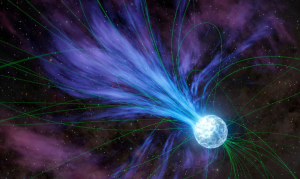
Scientists have detected a fast radio burst named FRB 20240304B that travelled about 10 billion years before reaching Earth. The signal was first detected on 4 March 2024 by the MeerKAT radio telescope in South Africa. Researchers used the James Webb Space Telescope to identify its host galaxy as a small, clumpy, low-mass, star-forming dwarf galaxy.
Fast Radio Bursts
Fast radio bursts are brief and intense pulses of radio waves from distant astronomical sources. FRBs are measured by their dispersion measure, redshift, and localisation to a host galaxy. Localised FRBs help astronomers study the intergalactic medium, galaxy evolution, and compact objects such as magnetars.
Cosmic Noon and Redshift
FRB 20240304B originated when the universe was about 3 billion years old, during a period called cosmic noon. Cosmic noon refers to the epoch of peak star formation in the universe, which occurred roughly 2 to 3 billion years after the Big Bang. The discovery doubled the redshift reach of localised fast radio bursts.
Radio Telescopes and Space Observatories
MeerKAT is a radio telescope array in South Africa that operates at radio wavelengths. The James Webb Space Telescope is a space observatory designed for infrared astronomy and studies distant galaxies, stars, and planetary systems. LOFAR, or the Low Frequency Array, is a pan-European radio telescope network used for low-frequency radio astronomy.
Important Facts for Exams
- FRB 20240304B is a fast radio burst and not a continuous radio source.
- The James Webb Space Telescope was launched in 2021 and operates in infrared wavelengths.
- LOFAR is used for low-frequency observations across Europe.
- Magnetars are highly magnetised neutron stars and are one proposed source of some fast radio bursts.
Galaxy Clusters and Mini-haloes
In June 2025, astronomers detected a radio mini-halo around the galaxy cluster SpARCS1049 with LOFAR. The mini-halo spans more than one million light-years and lies about 10 billion light-years away. Galaxy clusters are the largest gravitationally bound structures in the universe.
| Related | |
|---|---|