Russia Test-Fires Bulava Submarine-Launched Ballistic Missile
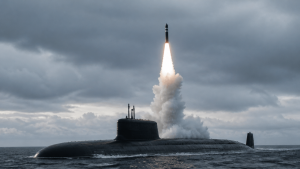
On 28 October 2026, Russia test-fired a Bulava intercontinental ballistic missile from the submerged Project 955A Borei-A-class nuclear-powered submarine Generalissimo Suvorov in the Sea of Okhotsk. The missile’s warheads reportedly reached their designated target at the Chizha test range in the Arkhangelsk region, also referred to as Cape Kanin.
Missile and submarine
The nuclear-capable Bulava (RSM-56) has a range exceeding 8,000 kilometres and can carry multiple nuclear warheads. Commissioned in December 2022, Generalissimo Suvorov can carry up to 16 Bulava missiles.
Russia’s Ministry of Defence called the launch successful and described it as “routine combat training”; the claims have not been independently verified by international media. The launch was presented as demonstrating Russia’s second-strike capability—the ability to retaliate with nuclear weapons after an initial attack on its nuclear forces.
Important Facts for Exams
- Propulsion stages: The Bulava has three stages: the first two use solid propellant, while the liquid-fuelled third stage allows greater manoeuvrability during warhead separation.
- Submerged firing: The Bulava can launch from an inclined position, allowing its submarine to fire while moving.
- Pump-jet propulsion: The Borei class introduced pump-jet propulsion on a Russian nuclear submarine, alongside a compact hull designed to reduce broadband noise.
- Borei-A control surfaces: Project 955A boats have all-moving rudders and vertical hydroplane endplates, design changes intended to improve manoeuvrability.
| Related | |
|---|---|