Tadoba Reserve Adds Sensors to Manage Wildlife Waterholes
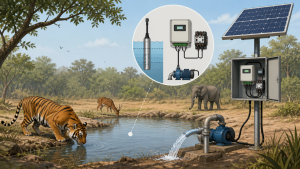
Tadoba-Andhari Tiger Reserve (TATR), in Maharashtra’s Chandrapur district, has introduced a sensor-based system on a pilot basis to manage water levels in wildlife waterholes. The system automatically starts and stops pumps according to water levels, with the stated aim of reducing water loss and maintaining water availability for wildlife.
Automatic water-level control
The device consists of a level sensor, a controller and a relay connected to a pump. The sensor detects when water falls below a predefined limit, and the controller activates the pump. When water reaches the upper level, the system switches the pump off. This operation prevents unnecessary pumping and overflow. Previously, some solar-powered pumps continued running after waterholes were full, while manual pump shut-off required staff to approach the sites.
Water sources and pumping systems
TATR has around 130 natural water sources and 350 artificial waterholes. Many of the artificial waterholes use solar-powered pumping systems. The new system is designed to reduce water loss and unnecessary groundwater extraction, while limiting the need for continuous human monitoring. Waterholes are managed water points that provide wildlife with access to water; artificial waterholes supplement natural sources in the reserve.
Spatial distribution of water sources
TATR has divided its core area into grids as part of work to improve the distribution of water sources. The plan is to provide waterholes in each grid, with the exercise expected to be completed in 2026. The sensor-based system was introduced amid concerns about drought conditions and future water availability. TATR’s field director described it as a first-of-its-kind approach to wildlife waterhole management.
Important Facts for Exams
- Tadoba-Andhari Tiger Reserve is located in Maharashtra’s Chandrapur district.
- TATR has around 130 natural water sources and 350 artificial waterholes.
- The sensor system uses a level sensor, a controller and a relay connected to a pump.
- The grid-based exercise is intended to provide waterholes across the reserve’s core area.
Tadoba-Andhari Tiger Reserve uses both natural water sources and artificial waterholes for wildlife water access.
| Related | |
|---|---|