Sikkim Identifies 40 High-Hazard Glacial Lakes
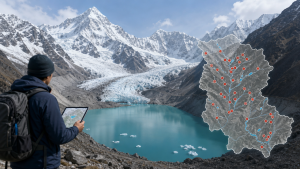
Sikkim has identified 40 high-hazard glacial lakes, including 16 in Category A, 2 in Category B, 9 in Category C, and 13 unclassified lakes. The state has also begun work on India’s first dedicated Glacial Lake Outburst Flood risk mitigation protocol for downstream settlements.
Glacial Lake Outburst Floods
A Glacial Lake Outburst Flood, or GLOF, is a sudden release of water from a glacial lake caused by dam failure, ice collapse, landslide, avalanche, or moraine breach. GLOFs can produce flash floods, debris flows, and river channel erosion in mountain valleys.
Risk Classification and Monitoring
Sikkim’s Department of Science and Technology is the nodal agency for monitoring these lakes. The monitoring system uses satellite imagery, remote sensing, geophysical investigations, bathymetric studies, and field surveys to assess lake volume, outlet stability, and surrounding terrain.
Category A lakes are treated as the highest-risk lakes for outburst, while Category B and Category C indicate lower but still significant hazard levels. Unclassified lakes are those that require further scientific assessment before final categorisation.
Mitigation Measures in Sikkim
The state government has submitted a Detailed Project Report to the National Disaster Management Authority for solar-powered pumping at Shako Chho Lake. The project aims to lower the water level of the lake, which has been identified as the most vulnerable glacial lake in the state.
The Central Water Commission and the Sikkim government are preparing a Detailed Project Report for a flood-retention structure at Dolma Sampa near Muguthang in the Lhonak Complex. The Department of Science and Technology is also working with the Brahmaputra Board on a moraine plug wall at the outlet of the Gurudongmar Complex.
Important Facts for Exams
- Sikkim is a Himalayan state with several glacial lakes in high-altitude basins.
- The National Disaster Management Authority is India’s apex body for disaster management under the Disaster Management Act, 2005.
- The Central Water Commission is a technical organisation under the Ministry of Jal Shakti.
- Bathymetric studies measure the depth and shape of water bodies and are used in lake hazard assessment.
Previous GLOF Events in Sikkim
The October 2023 GLOF in Sikkim caused at least 60 deaths, damaged districts including Mangan, Gangtok, Pakyong, and Namchi, and destroyed the Chungthang dam. The event increased attention on glacial lake monitoring and flood-risk reduction in the Teesta basin.
Regional Context
A glacial collapse near the Nepal-Tibet border on 26 August 2026 triggered flash floods in Nepal and caused large-scale casualties. Himalayan states and border regions use glacial lake mapping, early warning systems, and structural mitigation to manage GLOF risk.
| Related | |
|---|---|