China Plans 120 km Undersea Bullet Train Tunnel
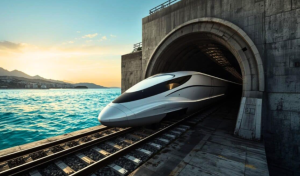
China is advancing plans for a massive 120-kilometre undersea high-speed rail tunnel across the Bohai Strait, aiming to connect the coastal cities of Dalian and Yantai in just 40 minutes. The proposed project, known as the Bohai Strait Cross-Sea Channel, represents one of the most ambitious infrastructure concepts under evaluation in the country’s expanding transport network.
High-speed rail link beneath the sea
The project envisions a dedicated rail tunnel stretching beneath the Bohai Strait, linking Liaoning and Shandong provinces. Designed for trains travelling at speeds exceeding 250 km/h, the corridor would significantly reduce travel time between the two cities. Currently, the journey relies on ferries or long detours around the Bohai Sea, often taking several hours.
Transforming regional connectivity
The proposed tunnel would integrate Dalian, a major industrial and port hub, with Yantai, a key centre in Shandong’s maritime economy. By replacing ferry-based transport with a fixed rail link, the project aims to enhance economic integration across the Bohai Rim region. It would also strengthen freight and passenger movement within northern China’s high-speed rail network.
Engineering challenges and design features
Building a tunnel of this scale presents complex engineering challenges, including seabed geology, fault lines, and seismic risks. The design includes artificial islands and vertical shafts to support ventilation, emergency access, and construction logistics. Engineers must also address environmental factors such as seasonal ice and heavy maritime traffic to ensure safety and durability.
Important Facts for Exams
- Bohai Strait lies between the Liaodong and Shandong peninsulas in China.
- High-speed rail typically operates above 250 km/h.
- Subsea tunnels require advanced ventilation and safety systems.
- Channel Tunnel between the UK and France is one of the longest existing subsea tunnels.
Project status and future outlook
The Bohai Strait Cross-Sea Channel is currently in the feasibility and evaluation stage, with ongoing studies on environmental impact, route alignment, and cost. Investment is expected to be substantial, potentially reaching hundreds of billions of yuan. If completed, the tunnel would rank among the longest undersea rail links globally and mark a major milestone in large-scale infrastructure development.
| Related | |
|---|---|