Republic Day Parade: Structure and Key Components
Introduction
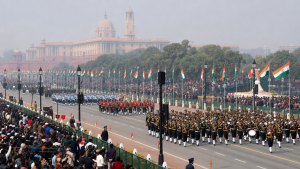
The Republic Day Parade is held every year on 26 January at Kartavya Path, New Delhi, to mark the coming into force of the Constitution of India. It is both a ceremonial event and a large-scale display of India’s military strength, cultural diversity and internal security preparedness.
The parade follows a fixed protocol and involves coordination among several ministries, the armed forces, police agencies and the Delhi administration.
Organizational Framework and Command Structure
- Primary coordinating body: The Ministry of Defence is the main nodal authority for the parade.
- Supporting agencies: It works with the Ministry of Culture, Ministry of Home Affairs and the Delhi Administration.
- Parade commander: The parade is commanded by the General Officer Commanding, Delhi Area, who holds the rank of Major General.
- Security arrangement: The Ministry of Home Affairs and the Delhi Police manage the security perimeter and crowd control.
- Civic logistics: The Delhi Administration handles seating, public amenities and venue-related infrastructure.
The parade requires precise coordination because it combines ceremonial protocol, military movement, public attendance and broadcast arrangements on a single route.
Opening Ceremonies and Protocol
- Tribute at National War Memorial: The ceremony begins with the Prime Minister paying homage to fallen soldiers at the National War Memorial near India Gate.
- Flag unfurling: The President of India unfurls the National Flag at the saluting base.
- National Anthem: The unfurling is accompanied by the National Anthem.
- 21-gun salute: A ceremonial 21-gun salute is fired using indigenously developed 105 mm Light Field Guns.
The 21-gun salute now uses indigenous 105 mm Light Field Guns, replacing the older British-era 25-pounder guns.
The opening sequence is tightly scripted and marks the formal start of the Republic Day Parade.
Structured Flow of the Parade
- Marching contingents: The parade begins with veterans, followed by contingents of the Army, Navy and Air Force.
- Paramilitary and police formations: Units from paramilitary forces and police organizations also take part.
- Mechanized columns: The Indian Army showcases tanks, armored vehicles, missile systems and radar equipment.
- Tableaux: Selected tableaux from states, Union Territories and central ministries present history, regional heritage and government schemes.
- Aerial flypast: The parade ends with a flypast by the Indian Air Force, featuring fighter jets, transport aircraft and helicopters.
The sequence moves from ceremonial participation to combat capability and finally to aerial display, making the parade a comprehensive showcase of national power.
Tableaux and Representation
- Selection process: An expert committee appointed by the Ministry of Defence evaluates tableau proposals.
- Committee composition: The panel includes artists, historians and academics.
- Purpose of tableaux: They highlight historical themes, cultural identity, development initiatives and regional traditions.
- Rotational MoU: A three-year rotational Memorandum of Understanding introduced in 2024 ensures that states and Union Territories get tableau representation at least once in three years.
This rotational system was introduced to address concerns over uneven representation and to make participation more inclusive across subnational entities.
Foreign Chief Guest Protocol
- Invitation process: The Ministry of External Affairs leads the selection and invitation of foreign heads of state or government as Chief Guest.
- Diplomatic significance: The choice reflects India’s foreign policy priorities and strategic partnerships.
- Historical origin: The tradition began with Indonesian President Sukarno at the first Republic Day in 1950.
The Chief Guest’s presence adds diplomatic value to the event and underlines India’s external relations alongside its domestic constitutional celebration.
Beating Retreat and Closing Ceremony
- Closing event: The Republic Day celebrations formally conclude with the Beating Retreat ceremony.
- Venue: It is held at Vijay Chowk, New Delhi.
- Timing: The ceremony takes place on the evening of 29 January.
- Performers: Bands of the armed forces and the Central Armed Police Forces participate in the musical performance.
The Beating Retreat marks the end of the Republic Day cycle and remains an important ceremonial event in its own right.
Key Prelims Takeaways
- Date and venue: Republic Day Parade is held on 26 January at Kartavya Path, New Delhi.
- Nodal ministry: The Ministry of Defence is the primary coordinating authority.
- Parade command: It is commanded by the General Officer Commanding, Delhi Area, of Major General rank.
- Opening tribute: The Prime Minister pays homage at the National War Memorial before the parade begins.
- Salute and flag: The President unfurls the National Flag and a 21-gun salute is fired using 105 mm Light Field Guns.
- Tableau rule: The 2024 rotational MoU provides representation to states and Union Territories at least once in three years.
- Closing ceremony: The celebrations conclude with Beating Retreat at Vijay Chowk on 29 January.
| Related | |
|---|---|