State Diplomacy in India: Roles and Legal Framework
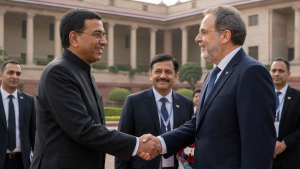
State diplomacy, or subnational paradiplomacy, refers to international activities undertaken by states and other subnational governments to promote trade, investment, tourism and institutional cooperation. In India, however, such engagement operates within a strongly centralised constitutional framework, where foreign relations remain the exclusive domain of the Union government.
States may interact with foreign entities for development purposes, but they do not possess sovereign powers in external affairs. Their international outreach is therefore subject to constitutional limits, Union oversight and administrative clearance.
Constitutional Basis of Foreign Affairs
- Article 246 and the Seventh Schedule: Foreign affairs fall exclusively under the Union List, placing them within the legislative domain of Parliament.
- Relevant Union List entries: Entry 10 covers foreign affairs, Entry 11 diplomatic, consular and trade representation, Entry 13 participation in international conferences, and Entry 14 entering into and implementing treaties.
- Article 253: Parliament can legislate on any subject, including subjects in the State List, to implement international treaties, agreements, conventions or decisions taken at international conferences.
- Article 73: The executive power of the Union extends to matters on which Parliament may legislate, ensuring that formal diplomacy, negotiations and communications are conducted by the Centre.
- No treaty-making power for states: States cannot independently sign or implement international agreements without central authorisation and oversight.
Role of the Ministry of External Affairs
- Nodal ministry: Under the Government of India (Allocation of Business) Rules, 1961, the Ministry of External Affairs (MEA) is the principal executive agency for foreign relations.
- States Division: The MEA created a dedicated States Division in October 2014 to coordinate with States and Union Territories.
- Economic facilitation: The division helps states with exports, tourism promotion, foreign direct investment (FDI) and access to overseas expertise.
- Policy coordination: It acts as a bridge between regional development objectives and India’s broader foreign policy priorities.
- Support role: The division advises states on global investor summits, international roadshows and other overseas outreach activities.
Political Clearance and Foreign Travel Rules
- Mandatory clearance: Political clearance, handled by the MEA’s Coordination Division, is required before foreign travel by public functionaries such as Governors, Chief Ministers, State Ministers, MPs and civil servants.
- Administrative purpose: The clearance system helps maintain diplomatic consistency and avoids mixed signals in external engagements.
- Cabinet Secretariat circular: A circular dated 6 May 2015 formalised the requirement for prior political clearance, along with clearance under the Foreign Contribution (Regulation) Act (FCRA), for foreign travel by public servants.
- Judicial travel issue: In April 2022, the Delhi High Court quashed the requirement for Supreme Court and High Court judges to obtain political clearance for private foreign travel.
- State-level outreach: Even when states conduct investor summits or roadshows abroad, their actions remain subject to Union foreign policy guidelines.
State MoUs and Recent Administrative Guidelines
- Non-binding MoUs: Revised central guidelines issued in March 2026 said that minor bilateral Memorandums of Understanding (MoUs) with no binding financial or national security implications do not require prior Cabinet approval.
- MEA vetting: Such MoUs must still be vetted by the MEA before signing to ensure consistency with national interests.
- Reporting requirement: After signing, the concerned state or local authority must report the MoU to the Cabinet within six months.
- Limited relaxation: The change reduces procedural delay, but does not alter the Union’s final control over external relations.
Paradiplomacy in the Indian Federal System
- Economic objectives: States use paradiplomacy mainly to attract investment, promote exports and enhance tourism.
- Subordinate character: Such engagement is not a parallel foreign policy; it remains subordinate to the Centre’s constitutional authority.
- Central supervision: Any overseas outreach by states must avoid conflict with India’s national security, diplomatic positions or treaty obligations.
- Practical flexibility: The system allows states to pursue development interests while preserving a unified international posture for India.
Key Prelims Takeaways
- Union control: Foreign affairs are exclusively under the Union List through the Seventh Schedule.
- Important entries: Entries 10, 11, 13 and 14 cover foreign affairs, diplomatic representation, international conferences and treaties.
- Article 253: Parliament can make laws on State List subjects to implement international agreements.
- MEA role: The Ministry of External Affairs is the nodal ministry for foreign relations and state coordination.
- States Division: Created in October 2014, it assists states in trade, tourism, FDI and international outreach.
- Political clearance: Foreign travel by key public functionaries requires prior MEA clearance under administrative rules.
- MoU rule: Minor non-binding state MoUs need MEA vetting and post-signing reporting, but not prior Cabinet approval under the March 2026 guidelines.
Current General Studies comprises current-affairs-based, General Studies-rich study material on policies, laws, institutions, economy, science, environment, governance, international relations, and other varied but important topics for UPSC and State PSC Prelims examinations.
Fortnightly PDF compilations: Available here
Originally written on
April 5, 2026
and last modified on
September 5, 2026.
| Related | |
|---|---|