NASA’s PUFFINS Mission to Study Interstellar Dust
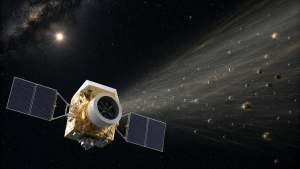
NASA’s PUFFINS mission, short for Polarimetry in the Ultraviolet to Find Features in INterStellar dust, is designed to study cosmic dust and its role in the search for extraterrestrial life. NASA selected the SmallSat for its competitive Astrophysics Pioneers program and has allocated it a budget of $20 million. The mission is scheduled to launch in April 2030.
Mission Design and Observations
PUFFINS will use a small satellite carrying a 10-inch telescope to observe ultraviolet light from about 70 stars. Its instrument will apply ultraviolet spectropolarimetry to examine the smallest grains of interstellar dust. Spectropolarimetry combines measurements of light across different wavelengths with measurements of its polarisation. Ultraviolet radiation is electromagnetic radiation with wavelengths shorter than visible violet light; the ultraviolet range is commonly defined as approximately 10 to 400 nanometres. Astronomical observations in this band can examine radiation from stars and material between stars. Interstellar dust consists of tiny solid particles distributed through the interstellar medium, which also contains gas.
Interstellar Dust and Polarisation
Interstellar dust absorbs and scatters starlight, producing interstellar extinction; shorter wavelengths are generally affected more strongly, causing the observed light to appear redder. Dust grains can become aligned with magnetic fields, and this alignment can polarise starlight passing through the interstellar medium. Measurements of polarisation across ultraviolet wavelengths can provide information about the properties and alignment of small dust grains. PUFFINS will study these particles in relation to the formation of stars and planets. Dust grains in molecular clouds can aggregate into larger bodies during the processes that form planetary systems. The mission also aims to investigate connections between dust properties and conditions relevant to the search for life.
Mission Leadership and Collaboration
The mission is a collaboration involving the University of Arizona, McDonald Observatory and other scientific institutions. Dr Ramya Manjunath Anche, an Indian-origin scientist from Bengaluru at the University of Arizona, is the Principal Investigator. NASA’s Astrophysics Pioneers programme selects small missions for astrophysics investigations.
Important Facts for Exams
- PUFFINS stands for Polarimetry in the Ultraviolet to Find Features in INterStellar dust.
- The mission is classified as a SmallSat and is scheduled for launch in April 2030.
- PUFFINS will observe approximately 70 stars using a 10-inch telescope.
- Interstellar extinction occurs when dust absorbs and scatters light travelling through the interstellar medium.
The mission’s stated budget is $20 million, and NASA selected it through the Astrophysics Pioneers program. Ultraviolet spectropolarimetry measures the wavelength-dependent polarisation of ultraviolet light.
| Related | |
|---|---|