NASA’s Nancy Grace Roman Telescope to map space 1,000 times faster than Hubble
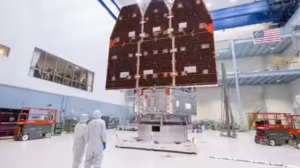
NASA Completes Roman Space Telescope Assembly
NASA has completed the final assembly of the Nancy Grace Roman Space Telescope, marking a major milestone ahead of its planned 2026 launch. Built at the Goddard Space Flight Center in Maryland, the observatory is expected to become one of the most powerful survey telescopes ever developed. Often seen as the next major mission after the Hubble and James Webb Space Telescopes, Roman will study dark energy, galaxy formation and distant planetary systems on an unprecedented scale.
The Roman Space Telescope is designed to observe the universe in visible and near-infrared light. Its main mirror is 2.4 metres wide, similar in size to the Hubble Space Telescope. However, its field of view is nearly 100 times larger in a single image. This allows it to scan large regions of space much faster. NASA says Roman can collect survey data nearly 1,000 times faster than Hubble, making it ideal for wide-field cosmic mapping.
Focus on Dark Energy and Dark Matter
One of Roman’s main scientific goals is to improve understanding of dark energy and dark matter, which together make up most of the universe. Dark matter cannot be directly seen but affects how galaxies move, while dark energy is believed to drive the accelerating expansion of the universe. Roman will create large three-dimensional maps of galaxies and trace how cosmic structures have changed over time, helping scientists refine theories of the universe.
Repeated Sky Scans and Supernova Detection
Roman is built to repeatedly scan the same large areas of the sky. This repeated observation helps scientists detect short-lived cosmic events such as supernova explosions. By observing the same region multiple times, astronomers can catch sudden changes that may otherwise go unnoticed. NASA expects the telescope to detect thousands of supernovae during its mission, providing critical data for understanding cosmic expansion.
What to Note for UPSC Prelims?
- Nancy Grace Roman is known as the “Mother of Hubble” for her role in advancing space astronomy.
- The Roman Space Telescope will operate from Lagrange Point 2 (L2), nearly one million miles from Earth.
- L2 is also the operating location of the James Webb Space Telescope.
- The telescope is expected to launch aboard a SpaceX Falcon Heavy rocket.
Exoplanet Search with Coronagraph
Roman also carries a specialised instrument called a coronagraph, which blocks bright starlight to reveal faint planets orbiting nearby. This may allow direct imaging of giant exoplanets such as gas giants similar to Jupiter. NASA says the instrument can detect planets up to 100 million times dimmer than their host stars. While it is not yet focused on Earth-like planets, the technology will help improve future missions searching for habitable worlds.
| Related | |
|---|---|