NASA James Webb Space Telescope Identifies Little Red Dots (LRDs)
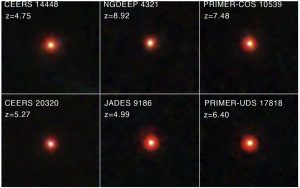
The James Webb Space Telescope (JWST), launched by NASA in December 2021, has detected a class of high-redshift objects called Little Red Dots (LRDs). These objects are compact, very red, and point-like in appearance, and they are observed in the early universe at large cosmological distances.
Little Red Dots
LRDs are characterised by a dominant red rest-frame optical continuum and a compact morphology. Astronomers have linked them to galaxies seen at high redshift, which means they are observed as they existed when the universe was much younger.
Competing Scientific Models
Three main models are used to explain LRDs. One model treats them as active galactic nuclei powered by supermassive black holes. A second model treats them as compact star-forming regions. A third model proposes that they are luminous stages of supermassive star progenitors before collapse.
Recent Observations and Black Hole Growth
In November 2025, JWST observations identified an actively growing supermassive black hole in an LRD named CANUCS-LRD-z8.6. This object was seen about 570 million years after the Big Bang. The black hole was described as overmassive relative to the stellar mass of its host galaxy.
Important Facts for Exams
- JWST is a space telescope operated by NASA and launched in late 2021.
- Chandra X-ray Observatory is NASA’s X-ray astronomy mission launched in 1999.
- High redshift objects are observed at earlier cosmic times because of the expansion of the universe.
- Supermassive black holes are found at the centres of many galaxies, including the Milky Way.
X-ray Dot and Transitional Phase
A newly identified X-ray-emitting object, 3DHST-AEGIS-12014, lies about 11.8 billion light-years from Earth. Researchers have linked it with a possible transitional phase between a dense “black hole star” stage and a typical growing supermassive black hole. Dense gas clouds around such objects can mask X-ray signatures used in black hole identification.
Early Universe Context
The Big Bang occurred about 13.8 billion years ago, and objects seen 570 million years after it belong to the early universe. LRD studies are used in astronomy to examine the formation of the first massive black holes and the growth of early galaxies.
| Related | |
|---|---|