NASA Finds New Moon Crater Larger Than Roman Colosseum
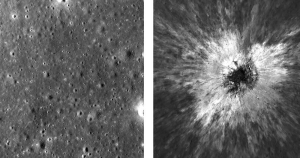
NASA’s Lunar Reconnaissance Orbiter (LRO) identified a new impact crater on the Moon’s near side that formed between 11 April and 22 May 2024. The crater has been named McGetchin after Thomas McGetchin of the Lunar and Planetary Institute in Houston, and it measures about 222 metres across and up to 43 metres deep.
Lunar Reconnaissance Orbiter
The Lunar Reconnaissance Orbiter is a NASA spacecraft launched in 2009 to map the Moon’s surface and environment. It carries cameras and instruments used to study lunar topography, illumination, radiation, and surface composition.
Impact Craters on the Moon
Impact craters form when asteroids, comets, or meteoroids strike a planetary surface at high speed. The Moon has no substantial atmosphere, so small and large impactors can reach the surface and create visible craters.
The McGetchin crater is described as the largest known recent impact crater in the solar system. It is about three times larger than the previous record-holder identified by LRO about a decade earlier.
Lunar Surface Effects
The impact excavated lunar material over a distance of more than 100 kilometres. Dust and rocky soil were thrown out at a higher angle than expected, and a cold spot about 7 kilometres wide was identified around the crater.
The cold spot is consistent with loosening of the Moon’s upper soil layer, which is called regolith. Lunar regolith is a layer of fragmented rock, dust, and impact debris that covers much of the Moon’s surface.
Scientific Study and Observation
Wide-angle images from LRO were processed in August 2025, and more detailed images were collected later in 2025. The discovery was confirmed in early 2026, and two studies were published on 15 September 2026 in Science Advances.
The impactor was estimated to be the size of a three- to six-storey building. The event was initially undetected by telescopes on Earth and in space.
Important Facts for Exams
- The Moon’s near side is the hemisphere that always faces Earth because the Moon is tidally locked.
- NASA’s Lunar Reconnaissance Orbiter has studied the Moon since 2009.
- Regolith is the loose surface layer found on the Moon, Mars, and several other airless bodies.
- Science Advances is a peer-reviewed journal published by the American Association for the Advancement of Science.
Exam-Relevant Facts
McGetchin is a fresh lunar impact crater formed in 2024 on the Moon’s near side. The crater was named after Thomas McGetchin of the Lunar and Planetary Institute.
| Related | |
|---|---|