NASA Finds 2.5-Billion-Year-Old Structure in Great Dyke
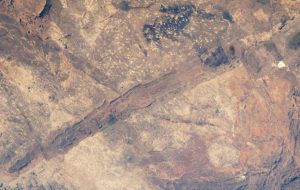
The Great Dyke of Zimbabwe is a 550-kilometre-long igneous formation that dates to about 2.5 billion years ago. NASA scientists have identified a hidden internal geological structure within it using satellite imaging and geophysics mapping. The feature is not visible on the surface and appears as a slight difference in the dyke’s inner composition.
Great Dyke of Zimbabwe
The Great Dyke extends from north-east to south-west across central Zimbabwe. Its width ranges from 3 to 12 kilometres. Geologically, it is classified as a lopolith rather than a traditional dike, and it has a flatter, saucer-like shape that lies parallel to existing rock layers.
Internal Geological Structure
The concealed structure is estimated to be 2.5 billion years old. Researchers working with NASA-funded data have linked it to an ancient magmatic pipe or a storage zone where magma cooled and chemically differentiated into mineral layers. Such structures are studied in relation to magma movement and mineral formation in the Archaean Eon.
Mineral Wealth and Geological Setting
The Great Dyke contains economically important metals such as platinum, chromium, nickel, copper, iron, titanium, vanadium and tin. Tectonic stability in the region has helped preserve the formation and its internal features over billions of years. The Great Dyke remains a major geological site for the study of early Earth crust formation and magma systems.
Important Facts for Exams
- The Great Dyke of Zimbabwe is about 550 kilometres long and 3 to 12 kilometres wide.
- It is about 2.5 billion years old and belongs to the Archaean geological history of Earth.
- A lopolith is a saucer-shaped igneous intrusion that lies parallel to surrounding rock layers.
- Zimbabwe’s Great Dyke is rich in platinum, chromium, nickel, copper, iron, titanium, vanadium and tin.
The Great Dyke is one of Zimbabwe’s most studied geological formations. Satellite imagery and geophysics mapping are key tools used to examine concealed subsurface structures.
| Related | |
|---|---|