Major International Groupings in Asia
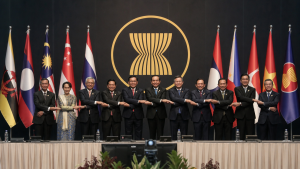
Asian regional groupings shape cooperation on trade, security, connectivity, and diplomacy. For India, they are important not only for neighbourhood outreach but also for wider Indo-Pacific engagement, maritime partnerships, and strategic balancing. The following groups are frequently asked in Prelims for their founding year, headquarters, membership, and key institutional features.
Association of Southeast Asian Nations (ASEAN)
ASEAN was established on 8 August 1967 through the Bangkok Declaration in Bangkok, Thailand. Its five founding members were Indonesia, Malaysia, the Philippines, Singapore, and Thailand. Later, Brunei Darussalam, Vietnam, Laos, Myanmar, and Cambodia joined, taking the membership to 10 states. The permanent secretariat is in Jakarta, Indonesia.
ASEAN aims to accelerate economic growth, social progress, and cultural development, while promoting peace and stability in Southeast Asia. It is guided by the principle of the ASEAN Way, which stresses non-interference, consensus-building, and quiet diplomacy.
- ASEAN Plus Three (APT): ASEAN, China, Japan, and South Korea.
- ASEAN Regional Forum (ARF): Established in 1994; a major security dialogue platform with 27 members.
- East Asia Summit (EAS): Formed in 2005; a premier forum for strategic dialogue on political, security, and economic issues.
- EAS members: 10 ASEAN members plus Australia, China, India, Japan, New Zealand, Republic of Korea, Russia, and the United States.
- India: A founding member of the EAS.
Bay of Bengal Initiative for Multi-Sectoral Technical and Economic Cooperation (BIMSTEC)
BIMSTEC was established on 6 June 1997 through the Bangkok Declaration. It brings together seven member states: Bangladesh, Bhutan, India, Myanmar, Nepal, Sri Lanka, and Thailand. The headquarters is in Dhaka, Bangladesh.
The grouping seeks economic and technical cooperation among littoral and adjacent countries of the Bay of Bengal region. It is seen as a bridge between South Asia and Southeast Asia, especially in the context of regional connectivity.
- Core areas: Trade, technology, energy, transport, tourism, and fisheries.
- Charter: Adopted at the 5th BIMSTEC Summit in Colombo, 2022.
- Strategic value: Important for India’s eastern neighbourhood and Bay of Bengal connectivity.
South Asian Association for Regional Cooperation (SAARC)
SAARC was established on 8 December 1985 in Dhaka, Bangladesh. Its permanent secretariat is in Kathmandu, Nepal. The organisation has eight member states: Afghanistan, Bangladesh, Bhutan, India, Maldives, Nepal, Pakistan, and Sri Lanka. Afghanistan joined in 2007.
SAARC was created to promote welfare, improve quality of life, accelerate economic growth, and strengthen social and cultural development in South Asia. It also emphasises collective self-reliance. Decisions are taken by unanimity, and bilateral disputes are generally kept out of its formal agenda.
- Key principle: Unanimity in decision-making.
- Associated bodies: SAARC Arbitration Council, SAARC Development Fund, and South Asian University.
- Exam angle: SAARC remains important for South Asian regionalism, though its political momentum has been limited in recent years.
Shanghai Cooperation Organisation (SCO)
The SCO was established on 15 June 2001 in Shanghai, China, evolving from the earlier Shanghai Five. Its headquarters are in Beijing, China, and its official working languages are Russian and Chinese. The organisation now has nine member states: China, Kazakhstan, Kyrgyzstan, Russia, Tajikistan, Uzbekistan, India, Pakistan, and Iran. India and Pakistan joined in 2017, and Iran joined in 2023.
The SCO seeks to strengthen mutual trust, good-neighbourliness, and cooperation in politics, trade, economy, science and technology, culture, and security. It has gained prominence in issues related to regional stability and counter-terrorism.
- Regional Anti-Terrorist Structure (RATS): A permanent SCO body headquartered in Tashkent, Uzbekistan.
- Function of RATS: Coordinates counter-terrorism efforts among member states.
- Strategic relevance: Important for Eurasian security and India’s continental diplomacy.
Indian Ocean Rim Association (IORA)
IORA was established in March 1997 in Mauritius. It has 23 member states from the Indian Ocean rim, including Australia, Bangladesh, India, Indonesia, Iran, Kenya, Madagascar, Malaysia, Maldives, Mauritius, Mozambique, Oman, Seychelles, Singapore, Somalia, South Africa, Sri Lanka, Tanzania, Thailand, the UAE, Yemen, Comoros, and France (for Réunion). The secretariat is located in Ebène, Mauritius.
The association promotes sustainable growth and balanced development in the Indian Ocean region. Its work covers maritime safety and security, trade and investment facilitation, fisheries management, and disaster risk management. IORA is relevant for India’s maritime strategy and wider Indo-Pacific engagement.
- Dialogue partners: 11, including China, Egypt, Germany, Japan, and the United States.
- Focus: Maritime cooperation and economic linkages across the Indian Ocean.
- Exam angle: IORA is often asked in relation to Indian Ocean geopolitics and sea-lane security.
Key Prelims Takeaways
- ASEAN: Founded in 1967 via the Bangkok Declaration; headquarters in Jakarta; 10 members.
- ASEAN-related forums: APT, ARF, and EAS are important extensions of ASEAN-led regional architecture.
- BIMSTEC: Formed in 1997; headquarters in Dhaka; 7 members; bridges South and Southeast Asia.
- SAARC: Established in 1985; headquarters in Kathmandu; 8 members; decisions are by unanimity.
- SCO: Founded in 2001; headquarters in Beijing; 9 members; RATS is in Tashkent.
- IORA: Established in 1997; secretariat in Ebène, Mauritius; 23 member states.
- India’s relevance: These groupings support Act East policy, strategic partnerships, and regional connectivity.
Recent Context
The second ASEAN-India Maritime Exercise (AIME-2026) began on 28 September 2026 at Subic Bay, Philippines. Indian Naval Ships INS Sahyadri and INS Kulish are participating with maritime forces from all ASEAN member states. The exercise is aligned with 2026 as the ASEAN-India Year of Maritime Cooperation.
| Related | |
|---|---|