Important Sectors in India’s Creative Economy
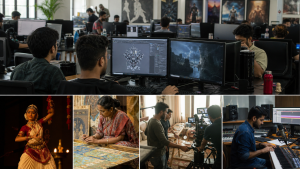
India’s creative economy brings together culture, technology, talent, and intellectual property to generate economic value. It spans traditional arts as well as digital media, making it an important source of jobs, exports, and innovation. For Prelims, the sector is best understood through its major industries, policy support, and recent institutional developments.
What is the Creative Economy?
The creative economy comprises industries where value is created primarily through creativity, culture, design, technology, and intellectual property. It includes cultural, artistic, and innovative goods and services, with creative inputs as the core resource. In India, this space connects heritage-based activities with modern digital platforms, allowing traditional skills and new-age content to contribute to national growth.
It is often referred to as the Orange Economy because of the distinct economic value generated by cultural and creative activities. The sector is also important for preserving cultural identity while expanding India’s global creative presence.
Major Sectors in India’s Creative Economy
- Audio-visual sector: Includes films, television, OTT platforms, and music. India’s film industry is a major global producer, while music ranges from folk traditions to contemporary genres.
- AVGC-XR: Stands for Animation, Visual Effects, Gaming, Comics, and Extended Reality. It is a fast-growing segment of digital content creation and immersive media.
- Applications of AVGC-XR: Used in film production, gaming, training, simulation, and interactive entertainment.
- AVGC-XR ecosystem: Includes creative studios, technology firms, educational institutions, and startup ecosystems linked to digital content production.
- Esports: Recognized as a competitive digital gaming sector and an important part of the wider gaming economy.
- Traditional arts, crafts, and heritage: Includes handicrafts, classical and folk dance, music, theatre, museums, and heritage-related cultural activities that support livelihoods and preserve traditions.
- Publishing and literature: Covers book publishing in multiple languages, digital publishing, and print and digital news media.
- Design and advertising: Includes fashion design, graphic design, product design, branding, and marketing services. This segment is highly relevant for creative goods and export-led growth.
Why These Sectors Matter for India
- Employment generation: Creative industries support jobs across production, design, media, content creation, performing arts, and allied services.
- Export potential: Creative goods and services contribute to India’s external trade and strengthen its presence in global markets.
- Cultural industries: The sector helps preserve traditional knowledge, local art forms, and heritage-based livelihoods.
- Innovation: Digital media, immersive technologies, and creative startups are expanding the sector’s scope beyond conventional arts.
- Soft power: Creative output such as films, music, digital content, and design improves India’s cultural visibility abroad.
- Technology linkage: The sector increasingly depends on technology-driven creation, distribution, and monetisation.
Government Initiatives and Policy Support
- National AVGC Policy Task Force: Constituted in 2022 by the Ministry of Information & Broadcasting and chaired by the I&B Secretary. It was tasked with recommending a national AVGC policy and a curriculum framework for AVGC-related courses.
- Key recommendations: Included a National AVGC-XR Mission, a budget-backed support structure, a Create in India campaign, an international AVGC platform, and a National Centre of Excellence.
- Education focus: The task force recommended using the National Education Policy to promote creative thinking and introducing AVGC course content at school level.
- Indian Institute of Creative Technology (IICT), Mumbai: Established as a National Centre of Excellence for AVGC-XR, with ₹400 crore allocated for its development.
- WAVES 2025: Organised to position India as a global hub for content creation. It led to WaveX, a startup-oriented innovation platform, and WAVES Bazaar, a marketplace for intellectual property.
- Create in India Challenge: A nationwide creative talent hunt covering animation, gaming, and AR/VR among other categories.
- Creative Economy Fund: A proposed USD 1 billion fund through public-private partnership to encourage investment and innovation in creative sectors.
- Startup India: Provides financial support and incubation opportunities for creative startups.
- Institutional and cultural support: Jaipur, Varanasi, and Srinagar are part of the UNESCO Creative Cities Network; Seven Zonal Cultural Centres conduct festivals and workshops; and the National Creators Award (2024) recognises digital storytellers.
- AVGC Content Creator Labs: Budget 2026-27 proposed support for IICT to establish these labs in 15,000 secondary schools and 500 colleges to nurture creative talent.
Economic Contribution and Global Reach
India’s creative economy has become a significant contributor to growth and employment. Its estimated market size was USD 35 billion in 2023. The sector contributes nearly 2.5% of GDP and provides livelihoods to about 8% of the workforce. In 2019, India’s creative exports, including goods and services, were close to USD 121 billion, with creative services alone accounting for almost USD 100 billion.
The design segment dominated creative goods exports, accounting for 87.5% in 2019. Growth prospects remain strong: the animation market is projected to reach USD 24.48 billion by 2032, while the gaming sector is expected to hit USD 9.2 billion by 2029.
Key Prelims Takeaways
- Creative economy: Industries driven by creativity, culture, technology, and intellectual property.
- Orange Economy: Another term used for the creative economy.
- AVGC-XR: Animation, Visual Effects, Gaming, Comics, and Extended Reality.
- Uses of AVGC-XR: Film, gaming, training, and simulation.
- National AVGC Policy Task Force: Constituted by the Ministry of Information & Broadcasting in 2022.
- IICT, Mumbai: National Centre of Excellence for AVGC-XR with ₹400 crore allocation.
- Economic significance: About 2.5% of GDP, 8% of the workforce, and USD 121 billion in creative exports in 2019.
- UNESCO Creative Cities Network: Jaipur, Varanasi, and Srinagar are members.
- WAVES 2025: Linked to content creation, WaveX, and WAVES Bazaar.
- Esports: Recognised as a competitive digital gaming sector.
- Design exports: Accounted for 87.5% of India’s creative goods exports in 2019.
Recent Context
The Indian Institute of Creative Technologies (IICT) signed five Memoranda of Understanding on September 30, 2026, at FICCI FRAMES 2026 in Mumbai. The agreements aim to strengthen the AVGC-XR ecosystem through industry-academia engagement, curriculum development, training, startup support, and infrastructure collaboration with key partners.
| Related | |
|---|---|