Important Volcanoes and Volcanic Islands of the World
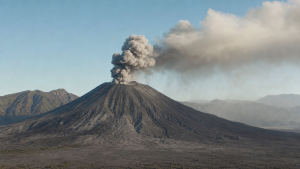
Volcanoes and volcanic islands are among the most important landforms created by the extrusion of magma, ash and gases from the Earth’s interior. Their global distribution reflects plate tectonics, mantle hotspots and subduction zones, making them essential for geography, disaster management and aviation safety.
Global Volcanic Belts and Distribution
Volcanoes are not randomly distributed. They cluster along plate boundaries and hotspot zones, where the Earth’s crust is either pulled apart, pushed together or punctured by mantle plumes.
- Pacific Ring of Fire: A horseshoe-shaped belt about 40,000 km long around the Pacific Ocean. It contains over 450 volcanoes and nearly 75% of the world’s active volcanoes.
- Subduction zones: Many of the most explosive volcanoes occur where one tectonic plate sinks beneath another, generating magma rich in silica and gases.
- Mid-Atlantic Ridge: A divergent boundary where plates move apart and new oceanic crust forms. Much of its volcanism is submarine, but it also creates islands such as Iceland and the Azores.
- Alpide Belt: Extending from the Mediterranean region through West and Central Asia, this convergent belt includes important volcanoes such as Mount Etna, Mount Vesuvius and Mount Ararat.
How Volcanic Islands Are Formed
Volcanic islands form when repeated eruptions build up lava and pyroclastic material on the seabed until the cone rises above sea level. Their shape and activity depend on whether they are associated with hotspots or plate-boundary volcanism.
- Hotspot islands: These form above relatively stationary mantle plumes, as seen in Hawaii.
- Island arcs: These form above subduction zones, where one plate descends beneath another, creating chains of volcanic islands.
- Basaltic lava: Low-viscosity lava spreads widely and can build broad shield volcanoes and island platforms.
- Andesitic lava: More viscous lava tends to form steeper cones and more explosive volcanic islands.
Famous Volcanic Islands and Archipelagos
Several volcanic islands are frequently asked in prelims because they illustrate different tectonic settings and eruption styles.
- Hawaiian Islands: Formed over a mantle hotspot beneath the moving Pacific Plate. The chain shows a clear age pattern, with Kauai older and the Big Island younger.
- Mauna Loa and Kilauea: Located on Hawaii Island, these are important examples of active shield volcanism.
- Aleutian Islands: A volcanic island arc in Alaska formed by subduction of the Pacific Plate beneath the North American Plate.
- Krakatau: Located in the Sunda Strait between Java and Sumatra. The 1883 eruption caused major global climatic effects and produced a famous caldera.
- Anak Krakatau: Meaning “Child of Krakatau,” it emerged in 1927 from the caldera created by the 1883 eruption.
- Aeolian Islands: Located in the Tyrrhenian Sea north of Sicily. Stromboli is known for frequent mild explosive eruptions, while Vulcano gave its name to the term volcano.
Volcanic Features of India
India has limited present-day volcanic activity, but it contains several important volcanic and igneous formations of exam relevance.
- Barren Island: Situated in the Andaman Sea, it is the only active volcano in South Asia. Its first recorded eruption was in 1787, with later activity in 1991, 1994-95 and 2017.
- Narcondam Island: Also in the Andaman Sea, this volcanic island is regarded as dormant or extinct. It is a wildlife sanctuary and is known for the endemic Narcondam hornbill.
- Deccan Traps: A vast basaltic province in west-central India formed by fissure eruptions about 66 million years ago, linked to the Reunion hotspot.
- Dhinodhar Hills: Located in Kutch, Gujarat, these are eroded remnants of an extinct volcano.
- Tosham Hills: Found in Haryana, these are extinct volcanic remnants associated with the Malani igneous suite of the Precambrian era.
Important Volcanoes of the World
| Volcano | Location | Key Geological Facts |
| Mauna Loa | Hawaii, USA | The world’s largest active shield volcano by volume. |
| Mount Vesuvius | Naples, Italy | A classic somma-stratovolcano; destroyed Pompeii in 79 AD. |
| Mount Fuji | Honshu, Japan | An active stratovolcano located near a tectonic plate junction. |
| Mount Merapi | Central Java, Indonesia | One of the most active and dangerous stratovolcanoes in the world. |
| Mount Pinatubo | Luzon, Philippines | Its 1991 eruption injected sulfur dioxide into the stratosphere. |
| Mount Cotopaxi | Andes, Ecuador | One of the highest active volcanoes in the world, at 5,897 metres. |
| Eyjafjallajökull | Iceland | A glacier-capped volcano whose 2010 ash plume disrupted European airspace. |
Volcanic Hazards and Disaster Management
Volcanic eruptions are not only geological events; they are also major disaster-management challenges. Ash, gases, lava flows, pyroclastic material and lahars can affect settlements, agriculture, transport and air routes.
- Shield volcanoes: These have broad, gentle slopes because low-viscosity basaltic lava spreads easily. Mauna Loa is a standard example.
- Stratovolcanoes: These are steep-sided and explosive because viscous, silica-rich magma traps gases. Mount Fuji and Mount Merapi are classic examples.
- Volcanic ash: Made of microscopic rock, mineral and volcanic glass fragments, it can damage aircraft engines when inhaled at high altitude.
- Engine hazard: Ash can melt inside jet engines, coat turbine blades and cause flameout, making volcanic ash a serious aviation risk.
- Caldera formation: A caldera is a large depression formed when a volcano collapses after a major eruption empties the magma chamber. Krakatau is a key example.
- VAACs: Volcanic Ash Advisory Centers are regional centres coordinated through ICAO and WMO to track ash clouds and issue aviation advisories.
Key Prelims Takeaways
- Pacific Ring of Fire: The world’s most important volcanic belt, associated with subduction and high seismicity.
- Hotspot volcanism: Hawaii is the best-known example of islands formed over a mantle plume.
- Island arcs: The Aleutians are a classic arc formed by oceanic subduction.
- India’s active volcano: Barren Island is the only active volcano in South Asia.
- Deccan Traps: A major basalt province linked to fissure eruptions and the Reunion hotspot.
- Aviation safety: Volcanic ash can shut down air traffic because it endangers jet engines and visibility.
- Caldera and crater: Krakatau is important for understanding collapse structures after major eruptions.
Recent Context
Mount Anak Krakatau in Indonesia’s Sunda Strait erupted on September 6, 2026, following eruptive activity that began on September 4. The event produced two ash plumes, with the higher plume rising to about 50,000 feet, prompting airspace restrictions and flight suspensions around Jakarta. Indonesia’s aviation and volcanology authorities issued safety advisories, highlighting the continuing link between volcanic hazards and civil aviation.
| Related | |
|---|---|