Burrowing Vertebrates and Fossorial Adaptations
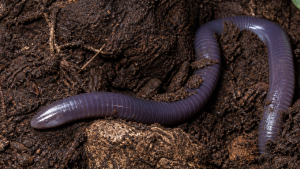
Fossorial vertebrates are animals adapted for life below the ground. Their body plan, senses and movement are modified to help them tunnel through soil, avoid predators and exploit underground food resources.
Among amphibians, caecilians are the clearest example of a truly burrowing lifestyle, and Indian species of the genus Gegeneophis are important for understanding this hidden diversity in the Western Ghats.
Morphological and physiological traits of fossorial vertebrates
- Limb reduction and elongation: Many fossorial vertebrates have reduced limbs or no limbs at all. A long, cylindrical body helps lower resistance while moving through compact soil.
- Cranial reinforcement: Burrowing forms often have a compact, heavily ossified skull that can push through soil and withstand pressure while tunnelling.
- Sensory modification: Vision is often reduced because underground habitats have little light. In compensation, smell, touch and chemical sensing become more important.
- Musculoskeletal adjustment: Species that retain limbs usually have short, strong bones and powerful girdles. Limbless forms move by body undulation and pressure changes within narrow burrows.
- Skin and scale changes: Smooth, moist or highly glandular skin reduces friction and helps prevent soil particles from entering body openings. In some species, specialised scales also occur.
- Physiological tolerance: Fossorial life often requires coping with low oxygen, high carbon dioxide and limited space, so underground animals may show special respiratory and metabolic adjustments.
Caecilians and the order Gymnophiona
- Taxonomic position: Caecilians belong to Gymnophiona, one of the three living orders of Amphibia, the other two being Anura and Caudata.
- Body form: They are limbless, worm-like amphibians with a cylindrical body suited to burrowing. Their external appearance is very different from frogs and salamanders.
- Annuli: The body is marked by ring-like grooves called annuli, which are useful in identification and species description.
- Eyes and senses: Eyes are usually small and may be covered by skin or bone. Since vision is limited underground, caecilians depend more on chemical and tactile cues.
- Sensory tentacle: A distinctive feature is the retractable tentacle located between the eye and nostril on each side of the head. It is linked to chemical sensing.
- Reproduction: Caecilians generally show internal fertilisation. Males use a specialised copulatory organ called the phallodeum.
- Habitat: They occur in moist soil, leaf litter and muddy ground, usually in tropical regions where underground moisture is sufficient for survival.
Fossorial adaptations and ecological role
- Movement through soil: The combination of a streamlined body, reinforced head and reduced limbs helps burrowing species move efficiently through earth and narrow tunnels.
- Protection from predators: Living underground reduces exposure to many predators, which is one reason fossoriality has evolved repeatedly in different vertebrate groups.
- Temperature and moisture control: Burrows buffer animals from extreme heat, cold and surface drying. This makes subterranean life especially useful in stressful environments.
- Feeding advantage: Underground animals may feed on earthworms, small invertebrates and other soil-dwelling organisms that are not easily available to surface species.
- Soil ecosystem function: By moving through soil, fossorial vertebrates help aeration, mixing and decomposition. They also influence nutrient cycling in moist forest floors and agricultural soils.
- Indicator of habitat quality: Because many burrowing amphibians need stable moisture and undisturbed soil, their presence often reflects healthy subterranean and forest-floor ecosystems.
Gegeneophis chandgadi and Gegeneophis valmiki
- Gegeneophis chandgadi: This subterranean, legless caecilian was discovered in Buzawade village in Chandgad tehsil of Kolhapur district, Maharashtra.
- Body features: It has a slender, flesh-coloured, worm-like body with primary annuli running the full length and secondary annuli concentrated on the posterior half.
- Formal description: The species was described in a paper published in the Records of the Zoological Survey of India in late August 2026.
- Name origin: The species is named after the Chandgadi dialect of Marathi spoken in the region where it was found.
- Gegeneophis valmiki: This rare caecilian was discovered on the Valmiki Plateau in Satara district, Maharashtra.
- Collection and publication: The first specimen was collected in 2017 by a senior scientist from the Zoological Survey of India, and the species was formally described in Phyllomedusa in January 2026.
- Distinctive trait: It is a blind caecilian whose eyes are concealed beneath its bony cranium, an adaptation suited to a subterranean life.
- Name origin: The species was named after the historic Maharshi Valmiki Mandir situated near the collection site.
Western Ghats and Indian distribution
- Global hotspot: The Western Ghats are a global biodiversity hotspot extending across Gujarat, Maharashtra, Goa, Karnataka, Tamil Nadu and Kerala.
- Centre of caecilian diversity: This mountain chain is a major centre of diversity for endemic caecilian species in India, especially the genus Gegeneophis.
- Moist microclimate: The damp forest floor and humid soil of the Western Ghats create suitable conditions for burrowing amphibians that depend on moisture to prevent desiccation.
- Habitat sensitivity: Because they live under leaf litter and in shallow soils, caecilians are vulnerable to land use change, soil disturbance and loss of natural moisture regimes.
- Conservation relevance: The discovery of new species from this region underlines the importance of protecting forest floors, streamside habitats and undisturbed soil layers.
Key Prelims Takeaways
- Gymnophiona: The amphibian order that includes caecilians, which are limbless and fossorial.
- Annuli: Ring-like grooves on the body of caecilians used as an important identification feature.
- Sensory tentacle: A unique chemical-sensing organ located between the eye and nostril in caecilians.
- Phallodeum: The male copulatory organ in caecilians, associated with internal fertilisation.
- Gegeneophis: An India-endemic genus of caecilians concentrated in the Western Ghats.
- Bony cranium shielding: A strong fossorial adaptation seen in Gegeneophis valmiki, where the eyes are concealed beneath bone.
- Soil ecosystem role: Burrowing vertebrates contribute to aeration, mixing and decomposition in soil habitats.
Recent Context
The formal description of Gegeneophis chandgadi from Kolhapur in late August 2026 and Gegeneophis valmiki from Satara in January 2026 highlights how much subterranean biodiversity in the Western Ghats remains undocumented. These findings also reinforce the conservation importance of moist forest floors and undisturbed soils.
Current General Studies comprises current-affairs-based, General Studies-rich study material on policies, laws, institutions, economy, science, environment, governance, international relations, and other varied but important topics for UPSC and State PSC Prelims examinations.
Fortnightly PDF compilations: Available here
Originally written on
September 7, 2026
and last modified on
September 7, 2026.
| Related | |
|---|---|