Important Maritime Security Concepts and Agreements
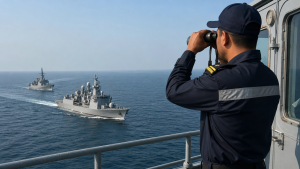
Maritime security covers the protection of sea routes, ports, coastal zones, and critical marine infrastructure from traditional and emerging threats. It is closely linked to international law, strategic cooperation, and the stability of global trade. For Prelims, the key focus areas include UNCLOS, regional defence frameworks, India’s maritime vision, and current security challenges at sea.
UNCLOS: The Legal Framework of the Seas
The United Nations Convention on the Law of the Sea (UNCLOS) is the principal international treaty governing maritime rights and obligations. Adopted in 1982 and entering into force in 1994, it is often called the “Constitution of the Oceans.” It provides the legal basis for a rules-based order at sea, peaceful navigation, and resource management.
- Territorial Sea: Extends up to 12 nautical miles from the baseline. The coastal state enjoys full sovereignty, subject to innocent passage for foreign ships.
- Contiguous Zone: Extends up to 24 nautical miles. States may enforce customs, fiscal, immigration, and sanitary laws.
- Exclusive Economic Zone (EEZ): Extends up to 200 nautical miles. Coastal states have sovereign rights over natural resources in the water, seabed, and subsoil, while other states retain navigation and overflight freedoms.
- Continental Shelf: Refers to the seabed and subsoil beyond the territorial sea, up to the outer edge of the continental margin or 200 nautical miles where the margin does not extend that far. Coastal states enjoy sovereign rights over its natural resources.
- High Seas: Areas beyond internal waters, territorial sea, archipelagic waters, and the EEZ. They are open to all states for navigation, overflight, fishing, and scientific research.
- International Seabed Area: A zone beyond national jurisdiction whose resources are the common heritage of humankind. The International Seabed Authority (ISA) regulates related activities.
Why Maritime Security Matters
Maritime security is no longer limited to piracy or naval conflict. It also includes economic disruption, environmental damage, trafficking, and sabotage of underwater systems. Since oceans carry most global trade, secure sea lanes and functioning port networks are essential for commerce, energy flows, and strategic stability.
- Sea lane security: Safe passage of commercial and military shipping across choke points and major routes.
- Global trade protection: Prevention of disruptions that can affect supply chains, fuel movement, and freight costs.
- National security: Guarding coastlines, ports, and offshore assets from hostile activity.
- Environmental safety: Preventing pollution, dumping, and damage to marine ecosystems.
- Rules-based order: Ensuring disputes are managed through law rather than coercion.
Major Contemporary Maritime Threats
Modern maritime threats are diverse and often transnational in nature. They require coordination among navies, coast guards, customs agencies, and legal authorities. Many of these threats overlap with organised crime and hybrid security challenges.
- Piracy and armed robbery: Violence or detention for private ends on the high seas or in maritime zones; the Gulf of Aden has been a major hotspot.
- Maritime terrorism: Terror-related attacks involving ships, ports, or offshore installations.
- Illegal, Unreported and Unregulated (IUU) fishing: Depletes fish stocks, damages habitats, and affects food security and livelihoods.
- Drug and arms trafficking: Smuggling networks exploit maritime spaces and weak enforcement capacity.
- Human trafficking and smuggling: Criminal groups exploit sea routes for illegal migration and exploitation.
- Environmental crimes: Include illegal dumping, oil spills, and other forms of marine pollution.
- Critical underwater infrastructure: Undersea cables, pipelines, and related systems need protection from sabotage or accidental damage.
Regional Cooperation: ADMM-Plus
The ASEAN Defence Ministers’ Meeting-Plus (ADMM-Plus) is an important Indo-Pacific defence cooperation platform. It supports collective responses to shared maritime security concerns and strengthens trust among regional and extra-regional powers.
- Formation: Established in 2010.
- Membership: Includes the 10 ASEAN member states and 8 dialogue partners.
- Dialogue partners: Australia, China, India, Japan, New Zealand, Republic of Korea, Russia, and the United States.
- Objective: To strengthen security and defence cooperation for peace, stability, and development in the region.
- Annual meetings: Defence ministers have met annually since 2017.
- Experts’ Working Groups: Address maritime security, counter-terrorism, humanitarian assistance and disaster relief (HADR), and cybersecurity.
India’s Maritime Vision and Strategic Partnerships
India places high importance on maritime security because of its long coastline, island territories, and central location in the Indian Ocean. Its maritime policy combines regional engagement, sea lane protection, and broader strategic cooperation in the Indo-Pacific and beyond.
- Act East Policy: Launched in 2014 to deepen India’s economic and strategic ties with the Indo-Pacific.
- Maritime focus under Act East: Includes secure sea lanes, maritime cooperation, and support for regional balance of power.
- SAGAR: Launched in 2015, meaning Security and Growth for All in the Region; it focuses on India’s maritime security capacities and cooperation with Indian Ocean littoral states.
- MAHASAGAR Vision: The acronym stands for Mutual and Holistic Advancement for Security and Growth Across Regions. It was articulated in March 2025 and expands India’s maritime engagement beyond the Indian Ocean to the broader Global South.
- Strategic continuity: MAHASAGAR builds on SAGAR while widening the scope of India’s maritime outreach.
- India-Philippines Strategic Partnership: Formally established in August 2025, with cooperation across defence and security, among other sectors.
Key Prelims Takeaways
- UNCLOS entered into force in 1994 and is the core legal framework for the oceans.
- Territorial Sea extends up to 12 nautical miles from the baseline.
- EEZ extends up to 200 nautical miles and gives coastal states resource rights.
- Contiguous Zone extends up to 24 nautical miles and allows enforcement of specified laws.
- ADMM-Plus was established in 2010 and includes ASEAN plus 8 dialogue partners.
- Act East Policy was launched in 2014 to strengthen India’s Indo-Pacific engagement.
- MAHASAGAR stands for Mutual and Holistic Advancement for Security and Growth Across Regions.
Recent Context
Indian Naval Ships Sahyadri and Kulish reached Subic Bay, Philippines, for an ADMM-Plus Joint Cooperation Activity. The exercise highlights maritime security and environmental resilience in the context of climate change, along with interoperability drills and exchanges among maritime forces.
| Related | |
|---|---|