Major Indian Foreign Policy Initiatives and Indo-Pacific Vision
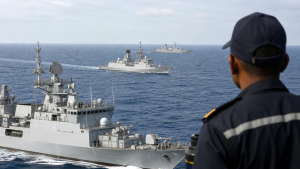
India’s foreign policy in the Indo-Pacific is increasingly defined by maritime outreach, strategic partnerships, and a rules-based regional order. For Prelims revision, the key themes are the Act East Policy, the MAHASAGAR vision, and India’s defence and security cooperation with Indo-Pacific partners.
Act East Policy
The Act East Policy is a major pillar of India’s foreign relations and a sharper version of the earlier Look East Policy, launched in 1991. Introduced in November 2014, it expanded India’s engagement with Southeast and East Asia beyond trade to include strategy, culture, and people-to-people ties.
- ASEAN centrality: ASEAN remains at the core of India’s Act East Policy.
- Connectivity: The policy stresses physical, digital, and people-to-people links.
- Commerce: It seeks deeper trade, investment, and supply-chain integration.
- Security: It supports defence cooperation and maritime security partnerships.
- Cultural links: It promotes shared civilisational and cultural connections across Asia.
The policy has become a key instrument for India’s engagement with the Indo-Pacific, especially through cooperation with ASEAN countries and other East Asian partners. It reflects India’s effort to combine economic diplomacy with strategic outreach.
MAHASAGAR Vision
India’s maritime outreach is guided by the MAHASAGAR vision, short for “Mutual and Holistic Advancement for Security and Growth Across Regions.” It was articulated by Prime Minister Narendra Modi in March 2025 and builds on the earlier SAGAR framework, which stood for Security and Growth for All in the Region.
- Expanded scope: MAHASAGAR extends India’s maritime vision beyond the immediate neighbourhood to the broader Global South and Indo-Pacific.
- Trade for development: Maritime routes are treated as channels for economic growth and regional prosperity.
- Capacity building: India supports littoral states in strengthening their maritime capabilities.
- Mutual security: The vision emphasizes cooperative responses to shared maritime challenges.
- Strategic partnerships: It seeks stronger ties with regional and global partners.
For exam purposes, MAHASAGAR is important because it shows how India links security, development, and maritime cooperation in a single strategic framework. It also reflects India’s attempt to present itself as a constructive actor in the Indo-Pacific.
Indo-Pacific Vision and Regional Engagement
India’s Indo-Pacific vision supports a free, open, inclusive, and rules-based regional order. It respects sovereignty and territorial integrity, and it favours the peaceful resolution of disputes. The approach combines diplomacy, maritime cooperation, and multilateral engagement.
- Multilateralism: India works through platforms such as Quad, BIMSTEC, and IORA.
- Maritime domain awareness: Information-sharing and surveillance cooperation are important priorities.
- HADR cooperation: Humanitarian assistance and disaster relief remain a major area of collaboration.
- Blue economy: India supports sustainable use of ocean resources for economic growth.
- UNCLOS: India upholds the United Nations Convention on the Law of the Sea in maritime governance.
India’s Indo-Pacific approach is not limited to naval presence. It also includes capacity building, connectivity, trade facilitation, and support for regional stability. This makes the Indo-Pacific vision both strategic and developmental in nature.
Bilateral and Multilateral Defence Cooperation
Defence cooperation is central to India’s maritime strategy. Through joint exercises, information sharing, and capacity-building initiatives, India strengthens interoperability with like-minded partners and contributes to regional security.
- Joint exercises: India regularly conducts naval exercises with the US, Japan, Australia, Singapore, and France.
- ADMM-Plus: India participates as a dialogue partner in the ASEAN Defence Ministers’ Meeting-Plus.
- Maritime security: Cooperation covers piracy, terrorism, illegal fishing, and other non-traditional threats.
- Training and patrols: India engages in training, coordinated patrols, and capacity-building with partner navies.
- Information sharing: Intelligence exchange and best practices support maritime awareness and preparedness.
Such defence ties help India project itself as a reliable security partner in the Indian Ocean and the wider Indo-Pacific. They also support the broader objective of maintaining a stable maritime commons.
India-Philippines Strategic Partnership
India and the Philippines established a strategic partnership in August 2025, reflecting growing convergence on maritime and regional security issues. The partnership aims to deepen engagement across multiple sectors, with maritime cooperation as a key focus.
- Maritime cooperation: The partnership supports cooperation on sea security and regional stability.
- Broader engagement: It opens the way for stronger collaboration across economic and strategic sectors.
- Shared concerns: Maritime security and rules-based order remain important drivers.
- Subic Bay: This is a major naval and logistics location in the Philippines.
- Philippine leadership: Gilberto C. Teodoro Jr. is the current Secretary of National Defense of the Philippines.
For India, such partnerships are important because they translate Indo-Pacific policy into practical cooperation. They also demonstrate India’s willingness to engage with ASEAN partners on security and connectivity issues.
Key Prelims Takeaways
- Act East Policy: Successor to the Look East Policy; launched in November 2014.
- Core focus: Commerce, connectivity, culture, and strategic cooperation with Southeast and East Asia.
- ASEAN centrality: ASEAN remains central to India’s Act East framework.
- MAHASAGAR: Stands for “Mutual and Holistic Advancement for Security and Growth Across Regions.”
- MAHASAGAR date: Articulated by Prime Minister Narendra Modi in March 2025.
- Indo-Pacific vision: Free, open, inclusive, and rules-based; supports peaceful dispute resolution.
- UNCLOS: United Nations Convention on the Law of the Sea; important for maritime governance.
Recent Context
Indian Naval Ships Sahyadri and Kulish are participating in the ADMM-Plus Joint Cooperation Activity at Subic Bay, Philippines. The deployment highlights India’s operational presence in the Indo-Pacific and its focus on maritime security, environmental resilience, and cooperation under the ADMM-Plus framework.
| Related | |
|---|---|