Important Concepts in Photovoltaic Systems
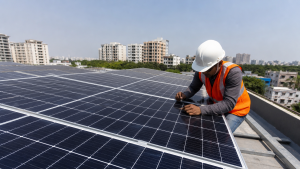
Photovoltaic systems convert sunlight directly into electricity using semiconductor solar cells. They are central to renewable energy because they generate direct current and can be scaled from small rooftop units to large utility plants. For Prelims, the key areas are the working principle, major cell technologies, system components, and the manufacturing chain.
Fundamentals of Photovoltaic Systems
- Photovoltaic effect: When sunlight falls on a solar cell, photons excite electrons in the semiconductor, creating an electric current.
- Solar cell: The basic unit of a PV system; it is a semiconductor device that converts solar radiation into direct current (DC) electricity.
- Modules and arrays: Solar cells are connected to form modules or panels, and multiple modules are combined into arrays for higher output.
- DC to AC conversion: PV systems produce DC electricity, which is converted into alternating current (AC) by an inverter for most household and grid uses.
- Grid integration: Efficient conversion and stable power output are important because solar generation varies with sunlight, temperature, and weather.
Solar Cell Technologies and Types
- Crystalline silicon cells: These are the most widely used solar cells and are made primarily from silicon.
- Monocrystalline silicon: Made from a single crystal structure, these cells usually have a uniform dark appearance and higher efficiency, generally around 18-24%.
- Polycrystalline silicon: Made from multiple silicon crystals fused together, these cells are usually blue and speckled, with slightly lower efficiency, about 15-20%, but are more cost-effective.
- Thin-film cells: These use very thin layers of photovoltaic material such as amorphous silicon, Cadmium Telluride (CdTe), and Copper Indium Gallium Selenide (CIGS).
- Thin-film advantage: They are lightweight and flexible, but generally have lower efficiencies, around 10-15%, and shorter lifespans than crystalline silicon cells.
- P-type solar cells: These use p-type silicon wafers doped with boron, creating holes as positive charge carriers. Many conventional solar cells have historically been p-type.
- N-type solar cells: These use n-type silicon wafers doped with elements such as phosphorus, giving a surplus of electrons and better resistance to light-induced degradation.
- HJT: Heterojunction technology combines crystalline silicon with amorphous silicon thin layers and is known for good temperature performance and high efficiency.
TOPCon and Efficiency Improvement
- TOPCon: Tunnel oxide passivated contact is an advanced solar cell architecture designed to reduce recombination losses.
- How it works: It uses a thin silicon dioxide tunnel oxide layer and a heavily doped polycrystalline silicon layer on the rear surface.
- Why it matters: By reducing carrier recombination, TOPCon improves conversion efficiency and is widely used in high-efficiency modules.
- N-type TOPCon: This combines n-type silicon with TOPCon architecture and is a major route for improving module performance in modern manufacturing.
- Exam relevance: In current solar manufacturing, efficiency improvement is closely linked to cell design, passivation, and reduction of electrical losses.
Key Components of a PV System
- Solar panels/modules: These are made by connecting multiple solar cells in series and parallel to capture sunlight and generate DC electricity.
- Inverter: Converts DC electricity into AC electricity for appliances and the power grid.
- Types of inverters: Common types include string inverters, micro-inverters, and hybrid inverters.
- Mounting structure: Supports the panels and is designed to withstand wind, weather, and the required tilt and orientation.
- Balance of system (BOS): Includes wiring, fuses, circuit breakers, disconnects, and ground fault protection.
- Charge controller: Used in off-grid or hybrid systems to regulate charging and prevent overcharging or deep discharging of batteries.
- Battery bank: Stores excess electricity for use at night or during periods of low sunlight.
Solar Manufacturing Value Chain and Wafer Technology
- Backward integration: In solar manufacturing, this usually covers ingot production, wafer slicing, cell fabrication, and module assembly.
- Ingot production: High-purity polysilicon is melted and formed into cylindrical crystals for monocrystalline production or large blocks for polycrystalline production.
- Wafer slicing: Ingots are sliced into very thin wafers, which act as the base substrate for solar cells.
- Cell fabrication: Wafers undergo doping, etching, and coating to become functional solar cells.
- Module assembly: Cells are connected, encapsulated, and framed to form solar modules or panels.
- G12R wafer size: This refers to a large-format wafer and cell size used in modern photovoltaic manufacturing, allowing higher power output per module.
- Zero Liquid Discharge (ZLD): ZLD is a water management system in which wastewater is treated and reused with minimal liquid waste discharge.
Key Prelims Takeaways
- PV systems: Convert sunlight into electricity using the photovoltaic effect.
- Solar cells: Are semiconductor devices, mainly based on silicon, that generate DC electricity.
- Monocrystalline vs polycrystalline: Monocrystalline cells are more efficient; polycrystalline cells are generally cheaper.
- N-type cells: Usually offer better performance and lower degradation than traditional p-type cells.
- TOPCon: Stands for tunnel oxide passivated contact and is a high-efficiency solar cell design.
- G12R: Refers to a large-format wafer and cell size used in modern photovoltaic manufacturing.
- ZLD: Means wastewater is treated and reused with minimal liquid waste.
Recent Context
Premier Energies commissioned a 7 GW N-type TOPCon G12R solar cell manufacturing plant in Naidupeta, Andhra Pradesh. The facility raised the company’s total solar cell manufacturing capacity to 10.6 GW and uses digital manufacturing systems, artificial intelligence, and a Zero Liquid Discharge system.
Current General Studies comprises current-affairs-based, General Studies-rich study material on policies, laws, institutions, economy, science, environment, governance, international relations, and other varied but important topics for UPSC and State PSC Prelims examinations.
Fortnightly PDF compilations: Available here
Originally written on
September 21, 2026
and last modified on
September 21, 2026.
| Related | |
|---|---|