Jonnagiri Gold Mine to Boost India’s Domestic Production
India is set to witness a major milestone in its mining sector with the launch of the Jonnagiri gold project in Andhra Pradesh’s Kurnool district. This will be the country’s first large-scale private gold mine since Independence. The project marks an important step towards reducing India’s heavy dependence on imported gold and strengthening the vision of Aatmanirbhar Bharat in the mineral sector.
India’s Dependence on Imported Gold
India imports more than 800 tonnes of gold every year, creating continuous pressure on foreign exchange reserves. Domestic production has remained very low for decades. The state-run Hutti Gold Mines in Karnataka remains the only major producer, yielding around 1.5 tonnes annually. The closure of the historic Kolar Gold Fields in 2000 created a major gap in large-scale domestic gold mining. This made India heavily dependent on global markets for its gold demand.
Jonnagiri Project and Its Scale
The Jonnagiri gold mine is spread across nearly 598 hectares covering Jonnagiri, Erragudi and Pagidirayi villages in Kurnool district. The project is being developed by Geomysore Services India Pvt Ltd, backed by Thriveni Earthmovers & Infra and Deccan Gold Mines Ltd. More than ₹400 crore has already been invested in the project. Andhra Pradesh Chief Minister N. Chandrababu Naidu is expected to dedicate the mine to the nation in early May 2026.
Production Capacity and Economic Importance
The processing plant was completed in just 13 months and is now in the final stage of pre-commercial operations. Certified resources stand at 13.1 tonnes of gold, while exploration indicates a possible reserve of up to 42.5 tonnes. At peak capacity, the mine is expected to produce nearly 1,000 kg of refined gold every year for the next 15 years. Experts believe this project can encourage more private investment in gold and critical mineral exploration across India.
Important Facts for Exams
- Jonnagiri in Andhra Pradesh is India’s first large-scale private gold mine since Independence.
- Hutti Gold Mines in Karnataka is currently India’s only significant operational gold producer.
- Kolar Gold Fields in Karnataka were once India’s most famous gold mines and closed in 2000.
- Gold mining is important for reducing import dependence and conserving foreign exchange reserves.
From Rock to Doré Gold Bars
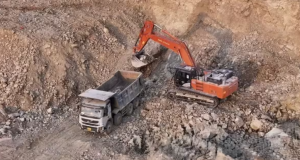
The mining process begins with open-pit mining using drilling and controlled blasting to break hard rock formations. Gold-bearing ore is then transported to the processing plant, where it is crushed and ground into fine particles. Gravity separation helps recover coarse gold, while finer particles enter the carbon-in-leach system using cyanide solution to dissolve remaining gold. The dissolved gold is absorbed onto activated carbon, followed by elution and electro-winning. Finally, smelting furnaces convert the recovered metal into doré bars, completing the transformation from ordinary rock into valuable gold.
| Related | |
|---|---|