ISRO Detects Possible Ice Beneath Moon’s Surface
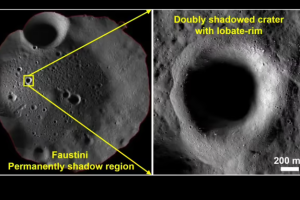
The Indian Space Research Organisation (ISRO) announced evidence of possible subsurface ice in cold craters near the Moon’s south pole on 27-28 May 2026. The finding used data from the Chandrayaan-2 orbiter and analysis by scientists from the Ahmedabad-based Physical Research Laboratory (PRL).
Chandrayaan-2 Orbiter and DFSAR
Chandrayaan-2 carries the Dual Frequency Synthetic Aperture Radar (DFSAR), a microwave imaging instrument designed to probe beneath the lunar surface. DFSAR is the first fully polarimetric synthetic aperture radar to study the Moon in both L-band and S-band frequencies.
South Polar Craters and Ice Detection
Strong evidence of subsurface ice was found in a 1.1-kilometre-wide crater inside the larger Faustini crater near the Moon’s south pole. The analysis focused on doubly shadowed craters, which are permanently shadowed regions that receive no direct sunlight for long periods. The identified craters showed Circular Polarization Ratio values greater than 1 and Degree of Polarization values lower than 0.13. These radar signatures are associated with volumetric scattering, a pattern used in lunar remote sensing studies of ice-bearing material.
Lobate-Rim Morphology and Thermal Conditions
The craters also displayed lobate-rim morphology, a flow-like rim structure recorded in impact features. The permanently shadowed regions near the lunar south pole remain at about 25 Kelvin, or -248°C, which is a temperature range that can preserve water ice over geological time periods.
Important Facts for Exams
- The Moon’s south polar region contains permanently shadowed craters that can remain at about 25 Kelvin.
- Circular Polarization Ratio and Degree of Polarization are radar parameters used in lunar surface studies.
- Faustini is a crater near the Moon’s south pole and contains smaller craters studied for ice signatures.
- DFSAR on Chandrayaan-2 works in L-band and S-band frequencies.
Lunar Water Resources
Water ice in lunar polar regions is relevant to in-situ resource utilisation and future human presence on the Moon. Lunar polar ice is also studied as a resource for future exploration missions.
| Related | |
|---|---|