India’s Total Fertility Rate Falls Below Replacement Level
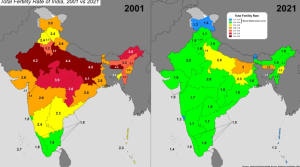
India’s Total Fertility Rate (TFR) fell to 1.9 in 2024, as measured by the Sample Registration System (SRS). The replacement fertility level is 2.1 children per woman, which is the standard used to assess whether a population can replace itself from one generation to the next.
Total Fertility Rate
The Total Fertility Rate is the average number of children a woman is expected to have during her reproductive years, usually defined as ages 15 to 49. A TFR of 2.1 is treated as the replacement level in many demographic studies because it accounts for child mortality and the sex ratio at birth.
State-wise Fertility Pattern
In 2024, Bihar recorded the highest TFR at 2.9 among the states listed in the data. Uttar Pradesh, Madhya Pradesh, Rajasthan, Chhattisgarh, and Jharkhand also remained above the replacement level, while Delhi recorded the lowest TFR at 1.2. Tamil Nadu, Kerala, and West Bengal each recorded a TFR of 1.3 in 2024. Rural India had a TFR of 2.1, while urban India had a lower TFR of 1.5.
Demographic Structure of India
India’s working-age population, defined as the 15-59 age group, formed 66.4% of the total population in 2024. The share of the elderly population, defined as persons above 60 years, rose from 8.6% to 9.7% over the last decade up to 2024. Kerala had the highest elderly population share at 15% in 2024. The National Family Health Survey-5, conducted during 2019-21, had earlier placed India’s TFR at 2.0.
Important Facts for Exams
- The replacement fertility level is 2.1 children per woman.
- The Sample Registration System is one of India’s key sources of demographic data.
- The National Family Health Survey-5 covered the period 2019-21.
- India’s working-age population is defined as the 15-59 age group.
Population Ageing
The elderly population in India is measured as persons above 60 years of age in official demographic data. Kerala’s elderly share of 15% was the highest among the states mentioned in the 2024 figures.
| Related | |
|---|---|