India Prohibits Exports of Lithium-Ion Battery Black Mass
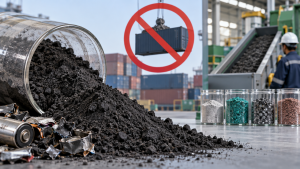
India has prohibited exports of lithium-ion battery black mass to support domestic recycling and critical mineral recovery. The Directorate General of Foreign Trade (DGFT) issued the notification on 10 November 2026 with immediate effect; the Commerce Ministry announced the measure on 11 November.
Export policy and domestic recycling
Black mass is the powdery material produced by shredding end-of-life lithium-ion batteries and manufacturing waste. It contains minerals including lithium, cobalt, nickel and manganese. Under ITC (HS) Code 85491400, its export policy has changed from ‘Free’ to ‘Prohibited’ until further orders.
India relies heavily on imports for critical minerals. The government intends the restriction to make black mass available as feedstock for domestic recycling and refining units. India’s battery-waste recycling capacity exceeds 60,000 metric tonnes a year, but has been underutilised because of inadequate feedstock, partly due to black mass exports.
The measure is expected to improve capacity utilisation, encourage investment, support employment and reduce import dependence. It complements the National Critical Mineral Mission and a ₹1,500-crore incentive scheme approved in September 2025 to develop recycling capacity for critical minerals from secondary sources.
Important Facts for Exams
- Black-mass separation: Direct recycling requires cathode black mass to be separated from other battery components; conventional shredding can introduce impurities into the cathode.
- Hydrometallurgical recovery: Hydrometallurgy extracts metals into aqueous solution, commonly with acids and a reducing agent, then selectively precipitates them as salts.
- Pyrometallurgical preparation: Pyrometallurgical processing separates cathode material from other cell components by incinerating organics in oxygen or decomposing them without oxygen.
| Related | |
|---|---|