Supreme Court Seeks Action Plan on Delhi-NCR Vehicle Pollution
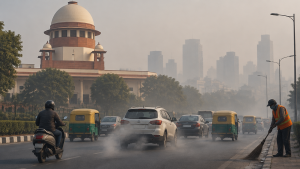
On 6 November 2026, the Supreme Court of India directed Delhi, Uttar Pradesh, Haryana and Rajasthan, the Municipal Corporation of Delhi (MCD) and Delhi Police to detail measures against polluting vehicles in the National Capital Region (NCR). The directions came during a suo motu case on air pollution in Delhi-NCR.
Enforcement details sought
A bench of Chief Justice Surya Kant and Justices Joymalya Bagchi and V Mohana gave the governments and authorities two weeks to file responses. They must describe existing enforcement, short- and long-term strategies, and rules governing private and commercial vehicles entering or moving through the region. The Court sought details of systems to identify vehicles that fail emission standards, including enforcement of Pollution Under Control (PUC) certification requirements. It also asked for figures on vehicles inspected, challans issued and vehicles refused entry, as well as information on coordination to monitor inter-state vehicle movement.
Emissions and next hearing
The bench noted that vehicular emissions were a growing concern despite a considerable reduction in stubble-burning incidents across the four states. It asked the states to respond to recommendations from the Commission for Air Quality Management (CAQM) and the amicus curiae, and to provide a time-bound roadmap for stronger enforcement. The next hearing on vehicle emissions and pollution in Delhi-NCR is scheduled for 23 November 2026.
Important Facts for Exams
- Bharat Stage mark: India’s Non Polluting Vehicle mark is mandatory on new motor vehicles and certifies conformity with the relevant Bharat Stage emission standards.
- Fresh-test requirement: The new-vehicle certification is valid for six months from sale; after that, the vehicle must be tested afresh.
- Secondary air injection: Secondary air injection supplies oxygen to exhaust ports so unburned hydrocarbons can finish burning, and can support catalytic-converter oxidation.
- Crankcase ventilation: Positive crankcase ventilation routes hydrocarbon-rich fumes into the engine intake to be burned instead of released directly into the atmosphere.
| Related | |
|---|---|