Universal Literacy and Elementary Education Schemes
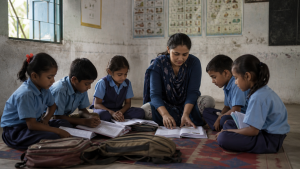
India’s framework for universal literacy and elementary education rests on constitutional guarantees, statutory entitlements, and targeted central schemes. Together, these measures aim to ensure access, retention, foundational learning, and adult literacy through coordinated funding and implementation.
Constitutional and Legal Mandates
- Article 21A: Inserted by the 86th Constitutional Amendment Act, 2002, it makes free and compulsory education for children aged 6 to 14 years a fundamental right.
- Article 45: Directs the State to provide early childhood care and education for children below six years of age.
- Article 51A(k): Makes it a fundamental duty of parents or guardians to provide education opportunities to their child aged 6 to 14 years.
- Right of Children to Free and Compulsory Education Act: Came into force on April 1, 2010.
- Neighborhood school norms: Mandates schools within one kilometer for primary classes and three kilometers for upper primary classes.
- Protection for children: Prohibits physical punishment, detention up to elementary grades, screening procedures for admission, and capitation fees.
- Private school quota: Provides 25 percent reservation in private unaided schools for children from economically weaker and disadvantaged groups.
Foundational Programmes for Elementary Education
- Operation Blackboard: Launched in 1987 after the National Policy on Education, 1986.
- Objective: To provide minimum essential physical facilities, teaching materials, and multi-grade teaching equipment to primary schools.
- District Primary Education Programme (DPEP): Launched in 1994 as a major centrally sponsored scheme for universal primary education.
- Planning model: Used district-specific decentralized planning with financial assistance from external funding agencies such as the World Bank.
- Significance: These programmes laid the groundwork for later integrated school education initiatives.
Contemporary Flagship School Education Schemes
- Samagra Shiksha: Launched in 2018 by subsuming Sarva Shiksha Abhiyan, Rashtriya Madhyamik Shiksha Abhiyan, and Teacher Education.
- Coverage: Provides an integrated framework from pre-school to senior secondary level.
- Support areas: Funds infrastructure development, uniforms, textbook procurement, and ICT labs in government schools.
- PM POSHAN: Formerly the Mid-Day Meal Scheme, launched originally in 1995.
- Coverage under the scheme: Provides one hot cooked meal to children studying in classes 1 to 8 in government and aided schools.
- Purpose: Improves nutritional status, boosts attendance, and helps eliminate classroom hunger.
- NIPUN Bharat Mission: Launched in July 2021 under the Samagra Shiksha framework.
- Goal: Achieve foundational literacy and numeracy for every child by the end of Class 3 by 2026-27.
Adult Literacy and Lifelong Learning
- National Literacy Mission: Established in 1988 to eradicate illiteracy in the age group of 15 to 35 years.
- Method: Relied on mass mobilization and volunteer campaigns.
- Nav Bharat Saksharta Karyakram (ULLAS): A central sector scheme approved for 2022 to 2027.
- Target group: Non-literates aged 15 years and above.
- Focus areas: Foundational literacy, numeracy, critical life skills, vocational skills, and continuing education.
- Learning continuity: These initiatives extend literacy efforts beyond school-age children to adults and lifelong learners.
Institutions and Policy Milestones
- National Policy on Education, 1968: The first official policy on education in independent India.
- Kothari Commission: Its recommendations formed the basis of the 1968 education policy.
- NCERT: Established in 1961 as an autonomous organization to advise the central and state governments on school education.
- NIEPA: Functions as a premier university for capacity building and research in educational planning.
- Samagra Shiksha funding: Operates on a cost-sharing ratio of 60:40 for general states and 90:10 for northeastern and Himalayan states.
- National Education Policy 2020: Replaced the 1986 policy and restructured school education into a 5+3+3+4 design covering ages 3 to 18.
- Sakshar Bharat: Implemented as a sub-scheme of the National Literacy Mission, targeting adult women in rural areas.
- National Translation Mission: Works under the Ministry of Education to make knowledge texts accessible in all scheduled Indian languages.
Scheme Snapshot
| Scheme / Mission | Launch Year | Target Group | Primary Objective |
| Sarva Shiksha Abhiyan | 2001 | Children aged 6 to 14 years | Universalization of elementary education |
| Mid-Day Meal Scheme | 1995 | Students in classes 1 to 8 | Nutritional support and school retention |
| Samagra Shiksha | 2018 | Pre-school to Class 12 students | Integrated school education development |
| NIPUN Bharat | 2021 | Children up to Class 3 | Foundational literacy and numeracy |
| ULLAS | 2022 | Non-literates aged 15+ years | Adult literacy and lifelong learning |
Key Prelims Takeaways
- Article 21A: Free and compulsory education for children aged 6 to 14 years is a fundamental right.
- RTE Act: Enforced from April 1, 2010, and includes neighborhood school norms and 25 percent reservation in private unaided schools.
- Operation Blackboard: Started in 1987 to strengthen primary schools with minimum facilities and teaching aids.
- DPEP: Launched in 1994 with decentralized district-level planning for universal primary education.
- Samagra Shiksha: An integrated school education scheme covering pre-school to senior secondary level.
- NIPUN Bharat: Aims at foundational literacy and numeracy by the end of Class 3 by 2026-27.
- ULLAS: Focuses on adult literacy, numeracy, vocational skills, and continuing education.
Current General Studies comprises current-affairs-based, General Studies-rich study material on policies, laws, institutions, economy, science, environment, governance, international relations, and other varied but important topics for UPSC and State PSC Prelims examinations.
Fortnightly PDF compilations: Available here
Originally written on
June 22, 2026
and last modified on
September 6, 2026.
| Related | |
|---|---|