Government Approves 12 Electronics Components Proposals Worth ₹7,503 Crore
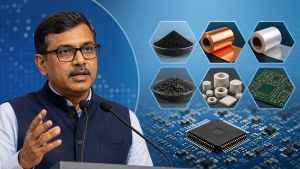
On 6 November 2026, the government approved 12 applications worth ₹7,503 crore under the Electronics Components Manufacturing Scheme (ECMS). IT Secretary S Krishnan announced the approvals in New Delhi.
Upstream manufacturing projects
The new approvals include materials and capital goods, extending ECMS support to upstream parts of the electronics supply chain. Products include Cathode Active Material, Anode Material, Copper Foil, Polypropylene Film and Specialty Ceramics, used in areas such as batteries, printed circuit boards and semiconductors. The projects are projected to generate production worth more than ₹39,000 crore and create over 7,000 jobs.
The government also launched the Semicon 2.0 web application portal under the Semicon India Programme on 6 November. Across the ECMS, 118 projects have now been approved in 16 states and 34 product categories. Their total approved investment is ₹77,051 crore, against the scheme’s enhanced budget of ₹40,000 crore.
Important Facts for Exams
- Rechargeable electrode chemistry: Rechargeable batteries restore their original chemical reactants when electric current reverses the discharge reactions, allowing repeated use.
- PCB copper patterning: Printed circuit boards laminate copper foil onto an insulating substrate; etching forms tracks, while vias connect copper layers.
- Battery current collectors: Conventional lithium-ion cells use copper foil as the anode current collector, while aluminium foil typically collects cathode current.
- Polypropylene capacitor dielectric: Polypropylene film is widely used as a dielectric in film capacitors; its low dielectric loss suits high-frequency and pulse applications.
| Related | |
|---|---|