DRDO Conducts Maiden NASM-SR Salvo Missile Launch
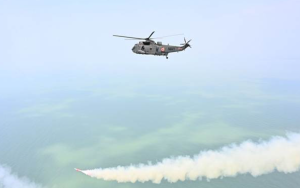
India achieved a significant milestone in defence capability with the successful maiden salvo launch of the Naval Anti-ship Missile–Short Range (NASM-SR). The test was jointly conducted by the Defence Research & Development Organisation (DRDO) and the Indian Navy from a helicopter platform off the Odisha coast in the Bay of Bengal. The launch marks a major advancement in indigenous missile technology and naval warfare preparedness.
Maiden Salvo Launch Achievement
The trial involved the firing of two missiles in quick succession from a single naval helicopter, demonstrating a salvo launch capability for the first time. Both missiles successfully met all operational objectives, including precision targeting and coordinated deployment. This achievement highlights India’s growing expertise in advanced air-launched anti-ship systems.
Advanced Tracking and Performance Validation
The test was closely monitored using sophisticated range tracking instruments deployed by the Integrated Test Range (ITR) at Chandipur. These included radar systems, electro-optical tracking devices, and telemetry systems. The missiles also demonstrated accurate waterline hit capability, a critical feature for effectively neutralising enemy ships.
Indigenous Technology and Key Features
The NASM-SR incorporates several advanced indigenous technologies. It uses a solid propulsion booster and a long-burn sustainer for enhanced range and performance. The missile is equipped with a fibre-optic gyroscope-based inertial navigation system, radio altimeter, advanced seeker, and high-bandwidth two-way data link. Jet-vane control and advanced guidance algorithms further improve precision and manoeuvrability.
Important Facts for Exams
- NASM-SR is an air-launched anti-ship missile designed for short-range operations.
- Integrated Test Range (ITR) is located at Chandipur in Odisha.
- Fibre-optic gyroscope is used in modern missile navigation systems.
- Salvo launch refers to firing multiple missiles in rapid succession from a single platform.
Development Collaboration and Strategic Impact
The missile system has been developed by the Research Centre Imarat, Hyderabad, in collaboration with multiple DRDO laboratories, including Defence Research & Development Laboratory, High Energy Materials Research Laboratory, and Terminal Ballistics Research Laboratory. Production involves Development-cum-Production Partners along with Indian industries and start-ups. The successful test is expected to significantly enhance India’s naval strike capabilities and strengthen its defence self-reliance.
| Related | |
|---|---|