Centre of Excellence on Human-Wildlife Conflict Inaugurated at WII-SACON
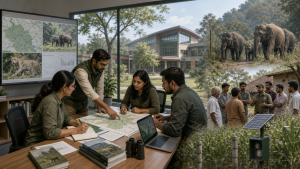
The Centre of Excellence on Human-Wildlife Conflict was inaugurated on 10 July 2026 at the Wildlife Institute of India–Sálim Ali Centre for Ornithology and Natural History campus in Coimbatore, Tamil Nadu. The inauguration was attended by the Union Minister for Environment, Forest and Climate Change, Bhupender Yadav, and the Union Minister of State for Environment, Forest and Climate Change, Kirti Vardhan Singh.
Human-Wildlife Conflict: Basic Concept
Human-wildlife conflict refers to negative interactions between people and wild animals, including crop damage, livestock depredation, property loss, and human injury or death. In India, conflict cases are commonly associated with elephants, leopards, tigers outside reserves, wild boars, and other large mammals.
Functions of the Centre of Excellence
The Centre of Excellence will work as a national hub for research, innovation, policy support, capacity building, and dissemination of best practices. Its mandate includes scientific and evidence-based management of human-wildlife conflict in India. The establishment of the Centre was announced by Prime Minister Narendra Modi during the 7th Meeting of the National Board for Wildlife on 3 March 2025. The National Board for Wildlife is a statutory advisory body under the Wildlife (Protection) Act, 1972.
Digital Tools and Publications
During the inauguration, the National Human-Wildlife Conflict Portal was launched as a digital platform for data management, knowledge sharing, and decision support for conflict mitigation. The first edition of Current Status of Human-Wildlife Conflict in India: An Overview was also released. The publication provides an assessment of current status, trends, and challenges related to human-wildlife conflict in India. The Centre’s approach includes the use of artificial intelligence, satellite mapping, and predictive analytics for conflict management.
Important Facts for Exams
- The Wildlife Institute of India is located in Dehradun, Uttarakhand, and it functions under the Ministry of Environment, Forest and Climate Change.
- Sálim Ali Centre for Ornithology and Natural History is a premier Indian institution for ornithology and biodiversity studies.
- The National Board for Wildlife was constituted under the Wildlife (Protection) Act, 1972.
- Elephants, leopards, and tigers are among the most frequently discussed species in Indian human-wildlife conflict management.
National Workshop on Conflict Mitigation
A National Workshop on Human-Wildlife Conflict was held after the inauguration and brought together policymakers, forest managers, scientists, and conservation practitioners. The workshop focused on mitigation strategies for conflict-prone landscapes in India.
Policy and Conservation Context
Human-wildlife conflict management in India involves wildlife protection, local livelihood security, and landscape-level planning. The use of AI, satellite mapping, and predictive analytics is part of the current shift towards technology-based conservation management.
| Related | |
|---|---|