Black Hole Awakens After 100 Million Years, Scientists Observe
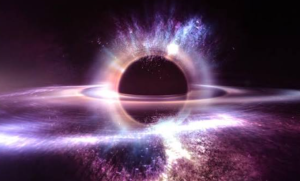
In a remarkable cosmic discovery, scientists have observed a supermassive black hole “wake up” after remaining dormant for nearly 100 million years. The sudden activation triggered a powerful burst of energy, likened to a volcanic eruption in space, offering fresh insights into the dynamic behaviour of black holes and their role in shaping galaxies.
What does a ‘waking’ black hole mean?
Black holes are not constantly active; they can remain dormant for extended periods when there is no nearby matter to consume. However, when gas, dust, or stars enter their gravitational influence, they become active again. In this case, the black hole resumed feeding, releasing intense radiation and high-energy emissions, marking a transition from inactivity to an active phase.
Cosmic volcano: nature of the eruption
The phenomenon has been compared to a volcanic eruption due to the sudden release of accumulated energy. Instead of lava, black holes emit powerful jets of particles and radiation into space. These outbursts can be extremely energetic, sometimes exceeding the combined energy output of all stars in a galaxy, significantly influencing their surroundings.
Impact on galaxies and space environment
Such eruptions play a crucial role in shaping galaxies by affecting star formation and redistributing gas and energy. The interaction between black holes and their host galaxies is a key area of study in astrophysics. Observations like these help scientists understand how galaxies evolve over millions of years.
Important Facts for Exams
- Supermassive black holes are located at the centres of most galaxies.
- Active Galactic Nuclei (AGN) emit enormous energy when black holes are active.
- Black holes can switch between active and dormant states.
- High-energy jets from black holes influence star formation in galaxies.
Scientific significance of the discovery
The finding highlights the cyclical nature of black holes and underscores the unpredictable behaviour of the universe. Such rare observations provide valuable data for astronomers to refine models of galaxy evolution and black hole activity. It also emphasises how much remains unknown about cosmic processes, reinforcing the need for continued exploration and research in space science.
| Related | |
|---|---|