White-rumped Vulture Conservation Challenges
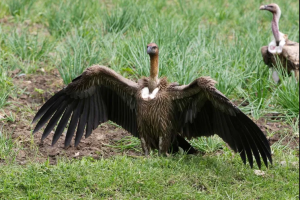
The white-rumped vulture is a Critically Endangered scavenger bird listed under the IUCN Red List. It occurs in South and South-East Asia, and its conservation involves poisoning control, carcass management, captive breeding, and protection from power line hazards.
Species Profile and Conservation Status
The white-rumped vulture is scientifically known as Gyps bengalensis. It is one of the three South Asian vulture species that suffered steep population declines after exposure to diclofenac and other toxic veterinary non-steroidal anti-inflammatory drugs. Vultures feed on animal carcasses and help remove carrion from the environment. Their decline has been linked to carcass poisoning, habitat change, and electrocution from overhead power infrastructure.
Recent Conservation Measures in Asia
In Cambodia, a white-rumped vulture was sighted in Lomphat Wildlife Sanctuary in June 2026 after a gap of about a decade. NatureLife Cambodia has used “vulture restaurants”, which are managed carcass-feeding sites, to support scavenger birds in protected landscapes. In Nepal, the project “Vultures, Cows and People – Strengthening an Ancient Relationship” began in October 2025 with Darwin Initiative funding. The project aims to create a second official Vulture Safe Zone around Shuklaphanta National Park. In India, the Bombay Natural History Society and state forest departments have planned the release of more than 700 captive-bred vultures into protected tiger reserves in Haryana, West Bengal, Maharashtra, and Assam by May 2026.
Threats from Poisoning and Infrastructure
Poisoning remains a major threat in vulture habitats, although cases in parts of Cambodia have fallen from more than 30 incidents a year to 1 to 3 cases annually. Toxic carcasses can kill multiple vultures at a single feeding site. A captive-bred, radio-tagged white-rumped vulture released in Mudumalai Tiger Reserve in June 2026 was electrocuted by a power line in the Nilgiris. Conservationists have called for bunch cabling and insulation of power lines in vulture habitats to reduce electrocution risk. Habitat loss, urban expansion, deforestation, and the disappearance of open carcass disposal sites also affect vulture foraging and nesting areas.
Important Facts for Exams
- The white-rumped vulture is listed as Critically Endangered by the IUCN.
- India banned aceclofenac and ketoprofen in August 2023 and nimesulide in 2024 for veterinary use harmful to vultures.
- GPS and radio tagging are used to track vulture movement, survival, and migration routes.
- Vulture Safe Zones are conservation landscapes designed to reduce poisoning and improve food safety for vultures.
Transboundary Movement and Monitoring
A GPS-GSM-tagged white-rumped vulture rescued in Bangladesh travelled 2,723 kilometres between Bangladesh and India in October 2024. Such records are used in vulture monitoring and cross-border conservation planning.
| Related | |
|---|---|