What Is BioSentinel?
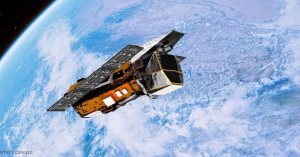
BioSentinel is a NASA astrobiology mission designed to study the effects of deep-space radiation on living organisms. Developed by NASA Ames Research Center, it uses a biosensor experiment involving budding yeast, scientifically known as Saccharomyces cerevisiae. The mission was the first in more than 40 years to collect direct experimental data from a biological study beyond Low Earth Orbit.
Mission Profile
BioSentinel is a low-cost, six-unit (6U) CubeSat measuring approximately 10 × 20 × 30 centimetres and weighing about 14 kilograms. A CubeSat is a small satellite built from standardised units, with each unit measuring approximately 10 centimetres per side. NASA launched BioSentinel on 16 November 2022 aboard Artemis 1, the first uncrewed flight test of the Artemis programme. It was the mission’s sole biological experiment and one of ten secondary payloads. After a lunar flyby, the spacecraft entered an Earth-trailing heliocentric orbit, meaning it travels around the Sun while following Earth at a distance.
Biological and Radiation Experiments
BioSentinel’s primary experiment was designed to detect and measure changes in yeast cells and relate them to DNA repair under prolonged exposure to space radiation. The experiment was intended to investigate radiation effects beyond Low Earth Orbit, where Earth’s magnetic field provides less protection than in near-Earth space. The spacecraft also carries a Linear Energy Transfer (LET) spectrometer. It measures the energy deposited by radiation as it passes through matter and is used to characterise the deep-space radiation environment. As of 31 July 2024, the spectrometer continued operating, including during the solar maximum period.
Mission Status and Findings
The biosensor hardware operated in deep space, but the yeast cells did not grow. The failure was considered likely to have resulted from the cells expiring during extended storage before launch, rather than from deep-space radiation. NASA extended the mission in August 2023 through November 2024 and later granted an extension of up to ten additional months, potentially through September 2025. The spacecraft’s projected end of life was December 2026. BioSentinel was approximately 36 million kilometres from Earth on 1 April 2024.
Important Facts for Exams
- Artemis 1 launched on 16 November 2022 and carried BioSentinel as a secondary payload.
- BioSentinel uses budding yeast, Saccharomyces cerevisiae, in its biological experiment.
- The Linear Energy Transfer (LET) spectrometer measures energy deposited by radiation in matter.
- A 6U CubeSat comprises six standard CubeSat units.
BioSentinel’s radiation measurements contribute to research on biological exposure during deep-space exploration. NASA identifies the mission’s research as relevant to planning future human missions to the Moon and Mars.
| Related | |
|---|---|