Types of Influenza Viruses and Their Transmission
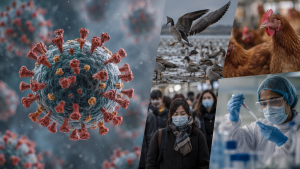
Influenza viruses are segmented RNA viruses that infect humans, birds and other animals. Their types differ in host range and disease impact, while surface proteins help define influenza A subtypes. Transmission occurs through respiratory particles and contact, and changes in viral genes can affect seasonal outbreaks and pandemic risk.
Types of Influenza Viruses
There are four influenza virus types: A, B, C and D. Their host range and epidemiological importance differ.
- Influenza A: Infects humans, birds and other mammals and is the only influenza type known to cause pandemics. It is classified into subtypes according to two surface proteins, haemagglutinin (H) and neuraminidase (N). There are 18 known H subtypes, H1–H18, and 11 N subtypes, N1–N11. More than 130 subtype combinations have been identified in nature, predominantly in wild birds. A(H1N1) and A(H3N2) are the influenza A subtypes that routinely circulate in humans.
- Influenza B: Primarily infects humans and commonly causes seasonal epidemics. It is grouped into the B/Yamagata and B/Victoria lineages rather than classified into subtypes. Influenza B generally changes more slowly than influenza A.
- Influenza C: Usually causes mild illness in humans and is not associated with epidemics. It can also infect pigs and dogs.
- Influenza D: Primarily affects cattle and is not known to cause illness in humans.
Haemagglutinin and Neuraminidase
Haemagglutinin and neuraminidase are influenza A surface proteins involved in infection and the release of newly formed virus particles. They are also important targets of the host immune response.
- Haemagglutinin (H or HA): Enables the virus to bind to host cells and initiate infection.
- Neuraminidase (N or NA): Helps new virus particles leave infected cells, facilitating their spread.
- Subtype designation: In H5N1, H5 indicates type 5 haemagglutinin and N1 indicates type 1 neuraminidase. The combination identifies the influenza A subtype.
Avian Influenza Pathogenicity
Avian influenza A viruses are classified as highly or low pathogenic according to the severity of disease they cause in domestic poultry. This classification does not directly predict how severe infection will be in humans or other species.
- Highly Pathogenic Avian Influenza (HPAI): Causes severe disease and can result in poultry mortality of up to 90–100% within 48 hours. Only certain H5 and H7 avian influenza A viruses are classified as HPAI.
- Low Pathogenic Avian Influenza (LPAI): Causes no signs or only mild signs in poultry, such as ruffled feathers or reduced egg production. Most avian influenza A viruses are low pathogenic, although some LPAI strains can mutate into HPAI viruses in poultry.
Transmission of Influenza Viruses
Influenza spreads mainly through respiratory droplets and aerosols. Contact with an infected person or contaminated objects can also transmit infection. Influenza A viruses may cross the species barrier, creating a public health risk when animal viruses infect people.
- Respiratory droplets: Coughing, sneezing and talking release larger droplets that may reach another person’s nose or mouth. Droplet spread generally occurs at close range, about two metres.
- Aerosols: Smaller particles can remain suspended in the air for longer and travel farther. Infection can occur when these particles are inhaled.
- Direct contact: Physical contact with an infected person can contribute to transmission.
- Indirect contact: The virus may be transferred from contaminated surfaces or objects, known as fomites, to a person’s mouth, nose or eyes.
- Zoonotic transmission: Animal influenza A strains, including those from birds or pigs, can infect humans. Such infections are rare and may follow unprotected exposure to infected animals or contaminated environments. Avian influenza A viruses such as H5N1 rarely infect people.
Antigenic Change and Pandemic Preparedness
Influenza viruses evolve through antigenic drift and, in influenza A, antigenic shift. These mechanisms matter for surveillance, vaccine effectiveness and pandemic preparedness because they can change how well existing immunity recognises a virus.
- Antigenic drift: Small, gradual genetic changes arise through point mutations, particularly in genes for H and N proteins. As changes accumulate, the immune system may not fully recognise a new strain despite prior immunity to similar strains.
- Seasonal impact: Drift contributes to seasonal flu epidemics and is a reason annual influenza vaccines are needed. Influenza A, B and C undergo antigenic drift.
- Antigenic shift: An abrupt, major change in an influenza A virus can produce new H or N surface proteins. Shift occurs when two different influenza A strains infect the same host cell and exchange genetic material through reassortment.
- Pandemic potential: Reassortment can produce a novel influenza A subtype to which most people have little or no immunity. Antigenic shift occurs only in influenza A and can lead to a pandemic.
Virus surveillance in humans, animals and poultry helps identify changes and potential cross-species infections. Understanding transmission and genetic reassortment is relevant to public health risk assessment and pandemic preparedness. Poultry containment measures, including surveillance, movement controls and biosecurity, are important when avian influenza is detected.
Key Prelims Takeaways
- Four types: Influenza A, B, C and D differ in hosts and epidemiological impact.
- Pandemics: Influenza A is the only type known to cause pandemics.
- A subtypes: H and N proteins define influenza A subtypes; 18 H and 11 N subtypes are known.
- HPAI and LPAI: These classifications describe disease severity in domestic poultry, not necessarily in humans.
- Drift and shift: Drift is gradual and occurs in A, B and C; shift is abrupt, involves influenza A reassortment and can have pandemic potential.
- Transmission: Routes include respiratory droplets, aerosols, direct or indirect contact, and, rarely, animal-to-human transmission.
Recent Context
On 13 November 2026, H5N1 was confirmed in a chicken carcass sample from Kattiyankuppam, Cuddalore district; the sample was collected on 5 November. By 13 November, 35,647 bird deaths had been recorded across 15 farms. Culling, movement restrictions and biosecurity measures followed the revised 2021 National Action Plan.
| Related | |
|---|---|