Important Big Cats and Their Conservation Status
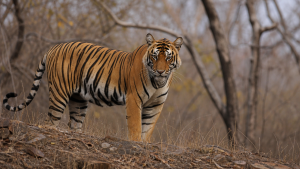
Big cats are among the most important apex predators in the animal world, and their status reflects the health of entire ecosystems. From tigers and lions to cheetahs and snow leopards, these species face rising pressure from habitat loss, poaching and conflict with people, making their conservation a major current affairs and Prelims topic.
Major Big Cat Species and Their Features
- Tiger (Panthera tigris): The largest living cat, known for dark vertical stripes on reddish-orange fur. Tigers are solitary, strong swimmers and occur across Asia, from Siberian forests to tropical rainforests.
- Lion (Panthera leo): A social cat that lives in prides. Male lions have prominent manes. They are found mainly in African savannas, with a small Asiatic population in India.
- Jaguar (Panthera onca): The largest cat in the Americas. It has rosette-shaped spots with inner dots and is a powerful swimmer and climber, often linked to dense forests and swampy habitats.
- Leopard (Panthera pardus): One of the most adaptable big cats, with the widest distribution among wild cats. Leopards are known for climbing trees with prey and have rosettes without inner spots.
- Snow Leopard (Panthera uncia): A cold-adapted cat of Central and South Asia. It has a thick grey-white coat, dark rosettes and a long tail used for balance in rocky terrain.
- Cheetah (Acinonyx jubatus): The fastest land animal, with a slender body, long legs and distinctive black tear marks. It belongs to the genus Acinonyx, not Panthera.
- Puma/Cougar (Puma concolor): Also called mountain lion, it has the widest range of any terrestrial mammal in the Western Hemisphere, from Canada to the southern Andes.
Conservation Status Under IUCN
- Tiger: Endangered.
- Lion: Vulnerable; the Asiatic lion subspecies is Endangered.
- Jaguar: Near Threatened.
- Leopard: Vulnerable.
- Snow Leopard: Vulnerable.
- Cheetah: Vulnerable; the Asiatic cheetah is Critically Endangered.
- Puma: Least Concern globally, though some regional populations are under pressure.
The IUCN Red List is the main global reference for species conservation status. For big cats, population decline is closely linked to shrinking habitat, prey loss and direct human pressure. Their decline also signals wider ecological stress because apex predators help regulate prey populations and maintain balance in natural systems.
Major Threats to Big Cats
- Habitat loss and fragmentation: Expansion of agriculture, urban growth and infrastructure breaks large habitats into smaller patches.
- Poaching and illegal trade: Big cats are hunted for fur, bones and other body parts.
- Human-wildlife conflict: Livestock predation often triggers retaliatory killings by local communities.
- Decline in prey base: Reduced availability of wild prey directly affects breeding and survival.
- Isolation of populations: Small and disconnected groups face inbreeding and lower genetic diversity.
India’s Legal and Policy Framework
- Wildlife (Protection) Act, 1972: The key law for protecting wild animals and plants. It prohibits hunting of listed species and provides legal backing to protected areas such as National Parks and Wildlife Sanctuaries.
- Schedule I protection: Major big cats such as tiger, lion and leopard receive the highest level of protection under the Act.
- Project Tiger: Launched in 1973 to ensure a viable tiger population in natural habitats and protect areas of biological importance as a national heritage.
- National Tiger Conservation Authority (NTCA): Oversees implementation of Project Tiger.
- Project Lion: Focused on conserving the Asiatic lion, especially in and around Gir National Park and Wildlife Sanctuary in Gujarat.
- Project Leopard: Leopard conservation is handled through broader wildlife protection measures rather than a separate flagship project.
- CA|TS: Conservation Assured | Tiger Standards is an accreditation tool that sets best practices for tiger conservation areas.
- CITES: India is a signatory to the Convention on International Trade in Endangered Species of Wild Fauna and Flora, which regulates international trade in endangered wildlife specimens.
Project Cheetah and India’s Reintroduction Effort
Project Cheetah is India’s ambitious attempt to reintroduce cheetahs, which were declared extinct in India in 1952. It began on September 17, 2022, with eight cheetahs from Namibia, followed by 12 from South Africa in February 2023 and nine from Botswana in February 2026.
- Main site: Kuno National Park in Sheopur district, Madhya Pradesh.
- Nature of the project: Translocation, breeding and habitat management.
- Significance: It is the first intercontinental translocation of a large carnivore into India.
- Population status: Of the 60 cheetahs in India, 53 are in Kuno National Park and four are in Gandhi Sagar Wildlife Sanctuary.
- Conservation value: The project is closely linked to species recovery, captive management, habitat restoration and genetic diversity.
Key Prelims Takeaways
- Tiger: Endangered on the IUCN Red List.
- Asiatic lion: Endangered; found in India.
- Cheetah: Vulnerable globally; Asiatic cheetah is Critically Endangered.
- Cheetah genus: Acinonyx, unlike other big cats mostly placed in Panthera.
- Fastest land animal: Cheetah.
- Project Tiger: Launched in 1973; implemented by NTCA.
- Wildlife (Protection) Act, 1972: Gives Schedule I protection to major big cats.
- Project Cheetah: Started on September 17, 2022.
- First batch: Eight cheetahs arrived from Namibia.
- Further translocations: 12 from South Africa and nine from Botswana.
- Main site: Kuno National Park, Madhya Pradesh.
- Additional site: Gandhi Sagar Wildlife Sanctuary.
- Conservation focus: Habitat restoration, breeding and genetic diversity.
Recent Context
On October 5, 2026, five cheetah cubs were born at Kuno National Park to KJP21, an India-born female cheetah. This raised India’s cheetah population to 60, including 41 born on Indian soil, and added the Botswanan lineage to the project. Earlier in 2026, Kuno also recorded births to Jwala and KGP12.
| Related | |
|---|---|