Major Israeli-Palestinian and West Asian Conflict Zones
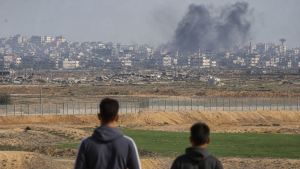
The West Asian region is shaped by overlapping territorial disputes, security dilemmas and shifting alliances. The Israeli-Palestinian conflict remains the core flashpoint, but tensions in Syria, Lebanon, Yemen and the wider Iran-Israel rivalry also affect regional stability and diplomacy. For Prelims, the key is to connect each conflict zone with its main actors, agreements and strategic significance.
Israeli-Palestinian Conflict: Core Issues
The Israeli-Palestinian conflict is rooted in competing claims over land, sovereignty and political identity. It intensified after the establishment of Israel in 1948 and the displacement of Palestinians, and further deepened after the 1967 Six-Day War, when Israel occupied the West Bank, Gaza Strip, East Jerusalem and the Golan Heights.
- Status of Jerusalem: Both sides claim Jerusalem as their capital. Palestinians seek East Jerusalem as the capital of a future state.
- Borders and settlements: Final borders remain unsettled. Israeli settlements in the West Bank are a major point of dispute.
- Refugees: The question of the Palestinian “Right of Return” for those displaced in 1948 and 1967 remains unresolved.
- Security: Israel seeks security guarantees, while Palestinians seek an end to occupation and greater freedom of movement.
- Water resources: Access to scarce shared water sources is an important issue in this arid region.
Major diplomatic efforts include the 1978 Camp David Accords, the 1993 and 1995 Oslo Accords and the 2003 Road Map for Peace. The Palestine Liberation Organization (PLO) is the recognised representative of the Palestinian people, with Fatah as its dominant faction. Hamas controls the Gaza Strip. UNRWA provides assistance to Palestinian refugees.
West Bank and Gaza Strip
These two territories are central to any future Palestinian state and remain the most sensitive parts of the dispute.
- West Bank: Located west of the Jordan River, it is largely administered by the Palestinian Authority but remains under Israeli military occupation.
- Settlements: Numerous Israeli settlements have expanded across the West Bank, making territorial contiguity difficult.
- Security barrier: Israel’s barrier has further complicated movement and access across the area.
- Gaza Strip: A small and densely populated coastal enclave, Gaza has been under Hamas control since 2007.
- 2005 disengagement: Israel withdrew troops and settlers from Gaza in 2005.
- Blockade: After Hamas took over, Israel and Egypt imposed a blockade citing security concerns.
- Conflict cycle: Gaza has seen repeated major confrontations between Israel and Hamas.
Golan Heights: Syria-Israel Front
The Golan Heights is a strategic plateau seized by Israel from Syria during the 1967 Six-Day War. It has high military value because it overlooks northern Israel and also contains important water resources feeding into the Sea of Galilee.
- Occupation and annexation: Israel effectively annexed the Golan Heights in 1981, but most of the international community does not recognise this move.
- 1974 Disengagement Agreement: After the 1973 Arab-Israeli War, Israel and Syria agreed to a ceasefire and separation framework.
- UNDOF: The United Nations Disengagement Observer Force was established in 1974 to monitor the area of separation and supervise the ceasefire line.
- Mount Hermon: This mountain lies near the tri-border junction of Syria, Lebanon and the Israeli-occupied Golan Heights.
Exam fact: The Golan Heights remains one of the most strategically important and disputed areas in the Syria-Israel front.
Lebanon and Wider Regional Stability
Lebanon has long been a major front in the Israel-Arab conflict, especially because of the role of non-state actors and the proximity of the border area to southern Lebanon.
- Hezbollah: A powerful Lebanese Shia Islamist political and militant group, backed by Iran, with a strong presence in southern Lebanon.
- 1982 Lebanon War: One of the major Israeli military interventions in Lebanon.
- 2006 Lebanon War: A major confrontation between Israel and Hezbollah.
- UNIFIL: The United Nations Interim Force in Lebanon was established in 1978 to confirm Israeli withdrawal and restore peace and security.
Broader West Asian Conflict Landscape
Beyond the direct Arab-Israeli theatre, wider West Asian disputes are shaped by regional rivalries, proxy conflicts and external interventions. Iran is a central player in several of these confrontations.
- Iran’s role: Iran supports non-state actors such as Hezbollah in Lebanon, Hamas in Gaza and the Houthi rebels in Yemen.
- Nuclear issue: Iran’s nuclear programme remains a major source of international tension.
- Yemen conflict: The war pits the Houthi rebels, backed by Iran, against the internationally recognised government supported by a Saudi Arabia-led coalition.
- Syrian civil war: This prolonged conflict has involved multiple internal and external actors, including Iran and Turkey, and has widened regional instability.
- Abraham Accords (2020): These agreements normalised ties between Israel and the UAE, Bahrain, Sudan and Morocco, but did not resolve the Palestinian issue.
Key Prelims Takeaways
- 1948: Establishment of Israel and the first Arab-Israeli War.
- 1967: Six-Day War; Israel occupied the West Bank, Gaza Strip, East Jerusalem and Golan Heights.
- 1973: Yom Kippur War.
- 1974: Israel-Syria Disengagement Agreement and creation of UNDOF.
- 1981: Israel effectively annexed the Golan Heights.
- 1993 and 1995: Oslo Accords between Israel and the PLO led to the creation of the Palestinian Authority.
- 2005: Israel disengaged from the Gaza Strip.
- 2007: Hamas took control of Gaza.
- 2006: Israel-Hezbollah war in Lebanon.
- 2020: Abraham Accords normalised Israel’s ties with several Arab states.
- PLO: Recognised representative of the Palestinian people.
- Hamas: Palestinian Islamist group controlling Gaza.
- Settlements: Israeli civilian communities in the West Bank, widely disputed under international law.
- UNDOF: Monitors the Golan ceasefire line.
- UNIFIL: UN peacekeeping mission in Lebanon.
Recent Context
Israel’s “Sufa 53” project, also called the “Great Storm” or “Sufa Line,” is an engineering and military undertaking in the southern Quneitra countryside of Syria near the occupied Golan Heights. Started in mid-2022 near Hader, it includes an 8-metre-wide road, trenches, earth berms and observation posts. Syria calls it a violation of the 1974 agreement; Qatar, Jordan and Kuwait condemned it on October 4, 2026.
| Related | |
|---|---|