Government Measures for Livestock Disease Management in India
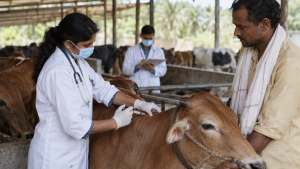
India’s livestock disease-management framework combines national policy, vaccination, surveillance, laboratory diagnosis and rapid outbreak response. The measures aim to protect animal health and farmer livelihoods while limiting risks to public health and the wider livestock economy.
Institutional Framework for Disease Management
The Department of Animal Husbandry and Dairying (DAHD), under the Ministry of Fisheries, Animal Husbandry and Dairying, is the nodal central agency. It formulates national action plans and coordinates animal disease-control programmes. State Animal Husbandry and Veterinary Services Departments implement control and containment measures on the ground. The National Institute of High Security Animal Diseases (NIHSAD), Bhopal, is a national referral laboratory for diagnosing and researching highly infectious animal diseases, including Avian Influenza. Indian Council of Agricultural Research (ICAR) institutes also contribute to veterinary research and vaccine development. Effective veterinary governance depends on coordination between central institutions, state services, laboratories and field-level teams.
National Animal Disease Control Programme
Launched in 2019, the National Animal Disease Control Programme (NADCP) is a flagship scheme funded entirely by the Centre. It targets Foot and Mouth Disease (FMD) and Brucellosis, with an aim to eradicate both diseases by 2030.
- FMD vaccination: The programme aims to vaccinate more than 500 million livestock.
- Brucellosis vaccination: It targets 36 million female bovine calves.
- Immunity: Vaccination campaigns are conducted annually to maintain high immunity among susceptible animals.
- Surveillance: Disease reporting and surveillance systems support the detection and monitoring of infection.
- Traceability: Animal identification, often through uniquely numbered ear tags, helps track animals and support disease-control operations.
Avian Influenza Management
India’s “National Action Plan for Prevention, Control, and Containment of Avian Influenza (Revised 2021)” guides bird-flu response. For Highly Pathogenic Avian Influenza (HPAI) in domestic poultry, it prescribes a “detect and cull” policy. Rapid containment, surveillance and biosecurity measures are intended to limit spread from affected premises.
- Surveillance: Poultry and wild birds are monitored, with increased farm surveillance in and around affected areas.
- Rapid response: Rapid Response Teams (RRTs) are deployed to conduct outbreak-containment operations.
- Culling zone: All birds at the epicentre farm and within a one-kilometre radius of a confirmed HPAI outbreak are culled.
- Disposal: Culled birds and contaminated materials are disposed of by deep burial in designated pits.
- Movement controls: Restrictions on bird movement are imposed in affected areas.
- Biosecurity: Premises are disinfected; agents such as VIRKON-S may be used as part of this measure.
- Restocking: Poultry restocking is typically prohibited in affected areas for three months.
- Compensation: DAHD provides funds to States and Union Territories on a 50:50 sharing basis to compensate farmers for culled birds, eggs and feed.
Other Disease-Control Programmes
- PPR Control Programme: Seeks to control and eradicate Peste des Petits Ruminants (PPR), a disease affecting small ruminants such as sheep and goats, through mass vaccination.
- Classical Swine Fever Control Programme: Uses vaccination and other control strategies to address Classical Swine Fever in pigs.
- Animal Health Disease Surveillance System (AHDSS): A national online platform for real-time reporting and monitoring of animal disease outbreaks, integrating information from state veterinary laboratories and field units.
- Assistance to States for Control of Animal Diseases (ASCAD): Provides financial assistance to states for disease prevention, control and containment, including diagnostics, epidemiology and vaccination.
Biosecurity and Veterinary Public Health
Farm biosecurity helps prevent disease entry and spread. Measures include controlled access, hygiene protocols and proper waste management. During outbreaks, movement controls, disinfection and safe disposal of contaminated material complement vaccination and surveillance. Veterinary public health addresses zoonotic diseases that can pass from animals to humans. The One Health approach recognises links among human, animal and environmental health, and calls for collaboration among medical, veterinary and environmental health professionals. Training for veterinary professionals and para-veterinarians supports the implementation of these measures. Disease outbreaks can also affect farmers’ incomes and local livestock activity. Timely detection, clear coordination between veterinary authorities and effective compensation arrangements are therefore relevant to economic resilience as well as animal health. Biosecurity regulation and veterinary capacity are important components of preparedness and response.
Key Prelims Takeaways
- DAHD: Nodal central agency for animal health policy and national action plans.
- NIHSAD, Bhopal: National referral laboratory for highly infectious animal diseases, including Avian Influenza.
- NADCP: Launched in 2019; targets FMD and Brucellosis, with eradication aimed for 2030 and 100% central funding.
- HPAI response: Revised 2021 action plan prescribes “detect and cull”; the culling zone extends one kilometre from the epicentre farm.
- Compensation: Centre-State funding is shared 50:50 for compensation relating to culled birds, eggs and feed.
- One Health: Integrates human, animal and environmental health.
Recent Context
H5N1 was confirmed on 13 November 2026 at a poultry farm in Kattiyankuppam, Cuddalore district, Tamil Nadu. RRTs were deployed, and culling within a one-kilometre radius, deep burial and a three-month restocking prohibition followed the 2021 action plan.
| Related | |
|---|---|