India’s Maritime Security Framework and Regional Cooperation
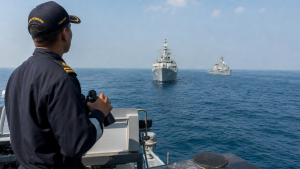
India’s maritime security framework combines naval defence, coastal law enforcement, intelligence-sharing and regional partnerships. Guided by SAGAR, India seeks to protect its maritime interests while supporting safe, stable and inclusive use of the Indian Ocean and its shared maritime commons.
SAGAR and India’s Maritime Vision
Introduced in 2015, SAGAR—Security and Growth for All in the Region—guides India’s cooperation with Indian Ocean countries. It links maritime security with economic growth and regional connectivity, while positioning India as a security provider and preferred partner. The approach reflects India’s reliance on maritime trade and the strategic importance of its coastline, which exceeds 7,500 km, and its Exclusive Economic Zone (EEZ), which spans more than 2.3 million sq km. For foreign policy, SAGAR provides a framework for practical cooperation with littoral states. Regional security efforts also support maritime infrastructure and connectivity, while addressing shared threats to shipping and offshore assets.
Institutional Framework and Coastal Security
India’s maritime security architecture assigns complementary roles to defence, law-enforcement and coastal agencies.
- Indian Navy: The primary instrument of sea power, responsible for maritime defence, deterrence and protection of India’s maritime interests, including sea lines of communication (SLoCs) and offshore assets. After the 2008 Mumbai terror attacks, it was designated the lead agency for overall maritime security, including coastal and offshore security.
- Indian Coast Guard (ICG): Established under the Coast Guard Act, 1978, and operating under the Ministry of Defence, the ICG performs armed-force, search-and-rescue and maritime law-enforcement functions. Its duties include coastal surveillance, anti-smuggling operations, marine environmental protection, including oil-spill response, and assistance to civil authorities in India’s territorial waters, contiguous zone and EEZ. It is ranked the world’s fourth-largest coast guard.
- Marine Police: Administered by the Ministry of Home Affairs, marine police forces in coastal states and Union Territories patrol shallow and near-shore waters up to 12 nautical miles from the coastline. They form an important layer of coastal security.
- Coastal Security Scheme (CSS): Launched in 2005 as a centrally sponsored scheme of the Ministry of Home Affairs, it strengthens coastal policing capacity and infrastructure. Phase I ran from 2005 to 2011, providing coastal police stations, check posts, outposts, interceptor boats and vehicles for surveillance and patrolling.
Coordination, Command and Exercises
Coordination mechanisms connect agencies and levels of government, helping address overlapping responsibilities and support a unified response to maritime threats.
- National Maritime Security Coordinator (NMSC): Created in 2022, the post provides a single point of contact and serves as the government’s principal maritime security adviser. The NMSC works under the National Security Advisor within the National Security Council Secretariat, supporting integration across civilian and military maritime domains.
- National Committee for Strengthening Maritime and Coastal Security (NCSMCS): Chaired by the Cabinet Secretary, this apex inter-ministerial body coordinates coastal security policy among central and state agencies.
- Information Management and Analysis Centre (IMAC): Established after the 2008 Mumbai attacks, this joint Indian Navy–Coast Guard intelligence hub collates and analyses maritime information to strengthen maritime domain awareness.
- Joint Operations Centres (JOCs): The Navy operates four JOCs—in Mumbai, Visakhapatnam, Kochi and Port Blair—to facilitate real-time coordination and intelligence-sharing among maritime stakeholders.
- Exercises: Sea Vigil, launched in 2019, is a biennial pan-India coastal defence exercise conducted by the Navy with the Coast Guard. States also participate in Operation Sagar Kavach drills, which test responses to infiltration scenarios.
Maritime Domain Awareness and Technology
Maritime Domain Awareness (MDA) depends on continuous monitoring, information-sharing and the ability to respond rapidly to suspicious activity and emergencies.
- IFC-IOR: Hosted by the Indian Navy in Gurugram, Haryana, the Information Fusion Centre–Indian Ocean Region was launched on 22 December 2018. It serves as a nodal centre of excellence for collaborative maritime safety and security in the region.
- White Shipping: The IFC-IOR fuses, analyses and disseminates information on merchant shipping, known as “White Shipping,” to support comprehensive MDA across the Indian Ocean.
- Technology and safeguards: AI analysis of satellite imagery, radar and vessel-tracking data can improve surveillance, help detect suspicious activity and support search-and-rescue operations. India also promotes access to technology, training and institutional capabilities for developing countries.
- Emerging risks: Cyber threats affect ports, vessels, communication networks and undersea infrastructure. India advocates safeguards, human oversight and clear accountability for autonomous systems, alongside the use of technology to strengthen human security.
International Law and Regional Cooperation
India’s maritime engagement combines international legal principles with operational cooperation and bilateral partnerships.
- Legal framework: India regards the United Nations Convention on the Law of the Sea (UNCLOS) and the work of the International Maritime Organization (IMO) as integral to the international framework for maritime security and safety.
- Freedom and safety at sea: India condemns attacks on commercial vessels and emphasizes freedom of navigation, lawful maritime commerce and the safety of seafarers.
- Anti-piracy cooperation: Indian naval ships have taken part in anti-piracy deployments in the Gulf of Aden and off Somalia since 2008. India became a full member of the Bahrain-headquartered Combined Maritime Forces in 2023 and assumed command of Combined Task Force 154 in February 2026.
- Bilateral arrangements: India maintains maritime security arrangements with Saudi Arabia, the United Arab Emirates, Bahrain and Qatar. A 2018 logistical agreement provided the Indian Navy access to Oman’s Duqm Port.
Key Prelims Takeaways
- SAGAR: India’s regional maritime vision, introduced in 2015.
- Lead agency: The Indian Navy leads overall maritime security, including coastal and offshore security.
- ICG and CSS: The Coast Guard Act was enacted in 1978; the centrally sponsored Coastal Security Scheme began in 2005.
- NMSC: Created in 2022; works under the NSA within the NSCS.
- IFC-IOR: Hosted in Gurugram and launched in December 2018; it shares White Shipping information to support MDA.
- Sea Vigil: A biennial pan-India coastal defence exercise launched in 2019.
Recent Context
On 29 October 2026, India’s Permanent Representative to the UN, Ambassador Harish Parvathaneni, identified AI and maritime security as priorities for India’s 2028–29 non-permanent UN Security Council candidature. India and Tajikistan are competing for the Asia-Pacific Group’s seat, with the election scheduled for June 2027.
| Related | |
|---|---|