Asiatic Lions in India: Habitat, Distribution and Conservation
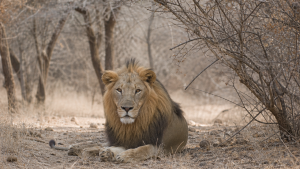
The Asiatic lion is a distinctive subspecies whose only surviving wild population occurs in Gujarat, India. Its recovery from near extinction reflects sustained conservation efforts, while its concentration in one state makes habitat expansion, connectivity and conflict management important priorities.
Status and Identity
The Asiatic lion (Panthera leo persica), also known as the Indian or Persian lion, is one of five big cat species found in India, along with the Bengal tiger, Indian leopard, snow leopard and clouded leopard. Its wild population is confined to Gujarat, with the Gir landscape as its principal habitat.
- IUCN Red List: Endangered.
- Wildlife (Protection) Act, 1972: Listed in Schedule I, which provides the highest level of legal protection under the Act.
- Conservation context: The population recovered from near extinction in the early 20th century, but its restricted range remains a significant risk.
Gir: Principal Natural Habitat
The Gir Forest landscape in Gujarat’s Saurashtra region is the core habitat of the Asiatic lion. It includes Gir National Park and Wildlife Sanctuary and surrounding forest areas. The protected landscape’s dry deciduous forests, scrub and grasslands support the lions and their prey.
- Protected area: Gir National Park and Wildlife Sanctuary was established primarily for Asiatic lion conservation.
- Habitat value: The varied forest and grassland ecosystem provides habitat and a prey base for the population.
- Conservation outcome: The lion population in Gir has grown over recent decades alongside sustained conservation efforts.
The concentration of the wild population in and around Gir means that conservation must protect the core habitat while also enabling dispersal to suitable areas. A geographically concentrated population may be vulnerable to disease outbreaks and natural calamities; this makes the development of an additional population an important conservation objective.
Barda Wildlife Sanctuary and Range Expansion
Barda Wildlife Sanctuary, in Saurashtra, covers 192.31 sq km across parts of Porbandar and Devbhumi Dwarka districts. It is being developed as an alternative habitat to reduce reliance on a single core range and support the establishment of another wild population.
- Return to Barda: Asiatic lions returned after an absence of approximately 144 years. Natural recolonisation began in January 2023, when a male dispersed into the sanctuary.
- Population augmentation: The Gujarat Forest Department subsequently introduced five female lions.
- Current population: Barda was home to 17 lions as of October 2026.
- Prey-base measures: In 2025–26, 441 chitals (spotted deer) were translocated from Gir Wildlife Sanctuary. Hundreds of spotted deer and sambar have also been released through captive-breeding efforts since 2007.
- Habitat assessment: The study “Beyond Gir: Barda Wildlife Sanctuary as a Potential Stronghold for Asiatic Lions”, published in PLOS One on September 9, 2026, examined Barda’s suitability as a long-term habitat.
Range expansion requires more than the presence of lions: a suitable habitat and adequate prey are also important. Barda’s recolonisation, prey augmentation and assessment as a potential long-term stronghold form part of this broader conservation effort.
Project Lion
Project Lion is the national programme for Asiatic lion conservation, launched by the Government of India in 2020. Its approach combines habitat management with monitoring and measures to address threats to the population.
- Programme priorities: Habitat improvement, disease surveillance, scientific monitoring and community participation.
- Barda’s role: The sanctuary is designated as Satellite Population 8 under Project Lion, reflecting its role in establishing an alternative habitat for the species.
- Scientific monitoring: Researchers fitted radio collars to six lions in Barda—one male and five females. More than 169,000 GPS locations recorded between January 2023 and July 2025 helped document habitat use, home-range establishment and social associations.
Monitoring can help assess how lions use a new habitat and whether they establish home ranges and social associations there. Such information supports planning for the management of Barda as a second population area.
Threats and Conservation Priorities
The recovery of the Asiatic lion does not remove the risks associated with its restricted distribution. Conservation needs to address threats within the core range while maintaining suitable habitat beyond it.
- Concentration of the population: Dependence on a single principal wild population increases exposure to epidemics and natural disasters.
- Habitat fragmentation: Fragmented habitat outside protected areas can restrict dispersal and gene flow, limiting connectivity between lion ranges.
- Human–wildlife conflict: Settlements and agricultural expansion near lion habitat can bring lions into conflict with people, including pastoral communities.
- Disease and poaching: A Canine Distemper Virus outbreak illustrates disease vulnerability in a concentrated population. Illegal hunting and trade in lion body parts remain potential threats.
Key priorities include protecting the Gir landscape, supporting prey and habitat conditions in Barda, improving connectivity, and addressing conflict with local communities. These measures complement legal protection and scientific monitoring by helping sustain populations across more than one suitable area.
Key Prelims Takeaways
- Species: Asiatic lion; scientific name Panthera leo persica; IUCN status Endangered; Schedule I under the Wildlife (Protection) Act, 1972.
- Distribution: Its only surviving wild population is in Gujarat, India; Gir is the principal natural habitat.
- Barda: Sanctuary of 192.31 sq km in Porbandar and Devbhumi Dwarka districts; natural recolonisation began in January 2023.
- Barda population: 17 lions as of October 2026, following return after approximately 144 years and the introduction of five females.
- Project Lion: Launched in 2020; Barda is Satellite Population 8.
- Prey and monitoring: 441 chitals were translocated in 2025–26; six radio-collared lions generated over 169,000 GPS locations from January 2023 to July 2025.
Recent Context
A September 2026 study in PLOS One assessed Barda’s potential as a long-term stronghold. Ecotourism began there in 2024, bringing 2,271 visitors in its first year and 3,359 in 2025–26, with local livelihood opportunities.
| Related | |
|---|---|