Major Maritime Security Initiatives in the Indian Ocean
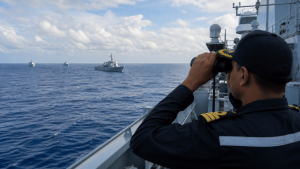
India’s maritime security approach combines regional cooperation, operational information-sharing and support for international maritime law. Its initiatives seek to improve maritime domain awareness, build capacity and promote a safe, stable and prosperous Indian Ocean.
SAGAR: India’s Maritime Vision
Security and Growth for All in the Region (SAGAR) was articulated by Prime Minister Narendra Modi in March 2015. It is a cornerstone of India’s Indian Ocean Region and Indo-Pacific policy, framing maritime security as a shared regional responsibility linked to economic cooperation and sustainable development. SAGAR’s objectives include ensuring maritime security and stability, promoting collective growth and safeguarding Sea Lines of Communication (SLOCs) and freedom of navigation. It also calls for stronger regional cooperation against traditional and non-traditional threats, improved Humanitarian Assistance and Disaster Relief (HADR) capabilities, and sustainable use of marine resources through the Blue Economy. The vision links security with regional prosperity: safe sea routes support lawful maritime commerce, while cooperation helps address risks that cross national boundaries. Its emphasis on shared growth also makes capacity building and the participation of regional partners important to maritime security.
Information Fusion Centre – Indian Ocean Region
The Information Fusion Centre – Indian Ocean Region (IFC-IOR) was launched in December 2018 and is hosted by the Indian Navy in Gurugram, Haryana. Conceived as a nodal centre of excellence for collaborative maritime safety and security, it supports maritime domain awareness (MDA) across the region. The centre is co-located with the Information Management and Analysis Centre (IMAC) and is jointly administered by the Indian Navy and Indian Coast Guard. Its operational core is the fusion, analysis and dissemination of “White Shipping” information. White Shipping refers to commercial, non-military merchant vessels. This information-sharing helps build a broader picture of maritime activity and supports the exchange of information on vessels of interest. IFC-IOR engages with partner countries and multinational maritime constructs to strengthen regional MDA. It has established linkages with nearly 30 countries and hosts International Liaison Officers from 12 to 15 partner nations, supporting collaboration and information exchange.
Technology, Maritime Awareness and Capacity Building
India advocates the responsible use of technology to strengthen human security and improve safety in shared maritime spaces. Artificial Intelligence (AI) can help analyse satellite imagery, radar and vessel-tracking data. These applications can improve MDA, assist in detecting suspicious activity and support search-and-rescue (SAR) operations. Access to technology is also a capacity-building concern. India calls for developing countries to have equitable access to relevant tools, alongside the training and institutional capabilities needed to use them. Regional cooperation in these areas can help partners improve their ability to monitor maritime activity and respond to incidents. Technological integration also brings risks. Ports, vessels, communication networks and undersea cables are among the critical maritime infrastructure exposed to cyber threats. India has called for safeguards, human oversight and clear accountability mechanisms for autonomous systems, so that technological use does not weaken security or responsibility.
International Law and Diplomatic Cooperation
India condemns attacks on commercial vessels and stresses freedom of navigation, lawful maritime commerce and seafarer safety. Its approach to maritime governance refers to the United Nations Convention on the Law of the Sea (UNCLOS) and the work of the International Maritime Organization (IMO), which provide an international framework for maritime conduct and cooperation. India has identified AI and maritime security as priorities for its candidature for a non-permanent United Nations Security Council (UNSC) seat in 2028–29. The election for the Asia-Pacific Group’s single seat is scheduled for June 2027, with India and Tajikistan competing. In September 2026, External Affairs Minister S. Jaishankar and Greek Foreign Minister George Gerapetritis co-chaired a United Nations event on AI and international peace and security, with an emphasis on maritime security. The focus reflects the growing connection between technology, regional maritime cooperation and the protection of shared maritime spaces.
Key Prelims Takeaways
- SAGAR: “Security and Growth for All in the Region,” articulated by Prime Minister Narendra Modi in March 2015.
- SAGAR priorities: Maritime security, SLOCs, freedom of navigation, HADR, regional cooperation and the Blue Economy.
- IFC-IOR: Launched in December 2018; hosted by the Indian Navy in Gurugram, Haryana.
- Administration: IFC-IOR is co-located with IMAC and jointly administered by the Indian Navy and Indian Coast Guard.
- White Shipping: Commercial, non-military merchant-vessel information used to support MDA.
- International frameworks: UNCLOS and the work of the IMO feature in India’s approach to maritime governance.
Recent Context
India has identified AI and maritime security as priorities for its 2028–29 non-permanent UNSC seat candidature. The Asia-Pacific Group election for its single seat is scheduled for June 2027, with India and Tajikistan competing.
| Related | |
|---|---|