The Northern Sea Route and India’s Maritime Stakes
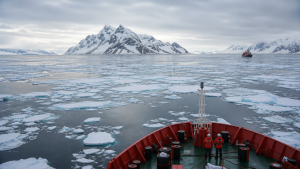
The Northern Sea Route is back in focus as Arctic ice melt makes the passage navigable for longer periods. A regular weekly container service launched by Chinese shipping company Sea Legend on August 15, 2026, has revived debate on whether faster polar shipping can alter global trade patterns by shortening shipping distances between Asia and Europe.
What is the Northern Sea Route?
The Northern Sea Route (NSR) is a 5,600-kilometer (3,500-mile) maritime corridor running entirely within Russia’s Exclusive Economic Zone (EEZ) along its Arctic coast. Spanning the Kara, Laptev, East Siberian, and Chukchi seas, it represents the shortest shipping connection between Europe and the Asia-Pacific region. Because it lies within Russia’s EEZ, Moscow maintains strict regulatory control over permits, icebreaker services, and navigation support, making the route highly geopolitical.
Why is the route becoming viable now?
Rapid Arctic warming has extended the seasonal navigation window of the NSR to approximately 160 days per year, compared to just 70 days in the 1980s. This transformation has enabled the transition from one-off voyages to regularly scheduled commercial services, highlighted by the launch of a weekly container service via the NSR by Chinese shipping company Sea Legend on August 15, 2026. Utilizing the NSR can cut transit distances between East/South Asia and Europe by up to 40% and shave 10 to 14 days off shipping times compared to the traditional Suez Canal route, making it a sought-after alternative to Middle Eastern chokepoints currently plagued by geopolitical instability.
| Feature | Suez Canal Route | Northern Sea Route |
|---|---|---|
| Approximate distance | 21,000 km | 13,000 km |
| Average transit time | 30 to 40 days | 18 to 25 days |
| Usability | Year-round | Seasonal, around 160 days |
| Main risk | Conflict, piracy, chokepoint disruption | Ice, cold, weak rescue cover |
How could shorter sea lanes affect global trade?
If polar navigation becomes predictable, shipping lines may move from test runs to seasonal services, altering freight patterns between East Asia, Europe, and the Russian Far East. However, the route will not replace the Suez Canal. High seasonal ice variation, shallow straits, and elevated operational costs limit its scale. It remains a seasonal alternative for select cargoes, while the main global trade flows continue through traditional southern lanes.
What are the strategic and environmental constraints?
Major strategic and environmental constraints persist along the NSR. Highly unpredictable ice conditions require specialized ice-class vessels and trigger steep insurance premiums. Emergency search-and-rescue infrastructure along the Russian Arctic coast remains limited. Furthermore, Western sanctions on Russia complicate vessel financing and dispute resolution. Environmentally, increased shipping threatens the fragile Arctic ecosystem with black carbon emissions, raising severe ecological dilemmas.
How does Arctic geopolitics shape the route?
Arctic geopolitics have grown highly competitive. Following Finland and Sweden’s accession to NATO, Russia remains the sole non-NATO member of the Arctic Council. This shift is highlighted by Canada’s March 2026 Arctic Defence Plan, the July 2026 joint security commitment by Canada and 11 European states, and the 2026 Ankara NATO summit positioning the “High North” as a critical defense front. Simultaneously, China’s “Polar Silk Road” initiative expands, escalating strategic competition over polar waters.
What does the route mean for India?
India’s maritime connectivity and trade security are tied to the operationalized Chennai-Vladivostok Eastern Maritime Corridor (EMC). Officially launched under India’s Minister of Ports, Shipping and Waterways, Sarbananda Sonowal, the EMC reduces cargo transport time between India’s east coast and Russia’s Far East from 40 days to 24 days. India is actively preparing to enter the Arctic shipping space, with S. Venkatesapathy, Joint Secretary in the Ministry of Ports, Shipping and Waterways, announcing at the Arctic-Regions Forum in Arkhangelsk on August 13, 2026, that India plans to dispatch its first pilot cargo vessel through the NSR in 2027.
Possible opportunities for India
- Shorter transit times to northern European and Eurasian markets during the summer navigation season.
- Deeper trade links with Russia’s Far East and resource-rich Arctic energy supply chains.
- Expanded opportunities for Indian shipyards through ongoing collaboration in building icebreakers.
- A stronger diplomatic footprint in polar affairs, building on its status as an Arctic Council observer.
Key challenges for India
- Balancing its strategic and energy partnerships with Russia against Western sanctions.
- Navigating the growing dominance of China’s “Polar Silk Road” initiative in the Arctic.
- High financial risks due to unpredictable ice conditions, specialized ice-class vessel requirements, and steep insurance premiums.
- Keeping polar ambitions aligned with its core strategic commitments in the Indian Ocean Region.
Way forward
India should treat the Northern Sea Route as a long-term strategic option. Bilateral logistics cooperation expanded in July 2026 when Russia and India signed a maritime cargo cooperation agreement along the NSR, which is complemented by ongoing collaboration in building icebreakers at Indian shipyards. To build operational capacity, India should leverage the landmark December 2025 Memorandum of Understanding (MoU) concluded during Russian President Vladimir Putin’s visit to New Delhi to train Indian seafarers for highly specialized shipping operations in polar waters. Working with multiple Arctic partners and adhering to environmental rules will help India secure its long-term interests in a changing polar order.
Practice Questions
- Arctic warming is altering maritime geography and trade routes. Discuss how the Northern Sea Route may affect global shipping patterns and the existing Suez-based trade system. (Answer in 250 words)
- Critically examine the strategic, legal and environmental challenges associated with the Northern Sea Route. How do these factors shape competition in the Arctic? (Answer in 250 words)
- Evaluate India’s emerging interest in polar shipping and Arctic connectivity. What measures should India take to secure its long-term maritime interests in a changing polar order? (Answer in 250 words)
| Related | |
|---|---|